Analysis
Breaking News
Culture
Industry
Lifestyle
News
Opinion
Politics
Regional
Sports
Top Stories
Uncategorized

The global economy has become an arena of open competition between major powers seeking to consolidate their influence through trade, investment, and industrial alliances (Shutterstock)
For three decades after the Cold War, economic efficiency – the ability of an economy to produce as many goods and services as possible at the lowest possible cost and without wasting resources – governed production, trade, and investment decisions, companies relied on supply chains that operated according to the logic of “timely,” while countries deepened their integration into the multilateral trading system.
However, this model has entered a phase of rapid reshaping, especially with the return of Donald Trump to the White House and the adoption of a more confrontational trade policy. His administration has already imposed additional tariffs on strategic Chinese and global imports, and expanded trade restrictions in sensitive industrial sectors.
Trump has also reintroduced sweeping tariffs on some imports, opening simultaneous pressure fronts on traditional partners, from his public criticism of European trade surpluses to direct pressure on Canada on industrial issues, and his demand that South Korea and India rebalance existing trade and defense arrangements.
The latest chapter of Trump’s trade policy was imposed last Friday by imposing temporary tariffs of 10% after the US Supreme Court canceled a large part of his tariffs, which were based on the Economic Emergency Act, and then Trump raised this rate to 15%, which is the maximum percentage allowed by law.
In the security context, the revival of the Greenland file as a U.S. strategic priority, and the linking of continued support to Ukraine to tougher negotiating terms, have raised questions in Europe about the long-term stability of the U.S. umbrella.
These developments have prompted a number of countries to accelerate their economic positioning and to seek blocs that are more stable and less susceptible to the fluctuations of U.S. political decision-making.
Thus, efficiency is no longer the only movement of trade and investment, but the concept of “economic security” has risen to become a central determinant of industrial centralization and capital allocation, while “conglomerate economies” are advancing as a regulatory pattern that redistributes risks and gains on clearer political lines.
The end of the priority of pure efficiency
The International Monetary Fund (IMF) warned in its 2023 Geoeconomic Fragmentation Report that the fragmentation of the global economy into competing blocs could reduce global output by between 2% and 7% in the long term, depending on the degree and depth of the sector. This recognition reflects a growing recognition that trade remapping does not come without cost to overall efficiency.
A study published in 2024 by researchers Sera Ayer and Sunil Unsorg of the University of Munich, titled “Geoeconomic Fragmentation and Intermediaries,” showed that global trade tends to be concentrated within ideologically convergent political circles, and that firms are reorienting supply chains toward partners seen as politically reliable.
The study showed that geopolitical considerations have become an important explanatory variable in models of bilateral trade flows, along with traditional factors such as distance and market size.
The decision-maker no longer balances only cost and efficiency, but also puts “economic security” at the heart of the calculations.
In a speech in Brussels in June 2023, European Commission President Ursula von der Leyen stressed that Europe is not seeking to disengage from China, but to “remove risks.”
The British newspaper Financial Times quoted her on June 20, 2023, as saying, “We don’t want to break away from China, but we need to reduce the risks.” This statement embodies a conceptual transition from an economy governed by marginal cost considerations to an economy in which policy redefines acceptable risk limits.
The Rise of “Bloc Economies”
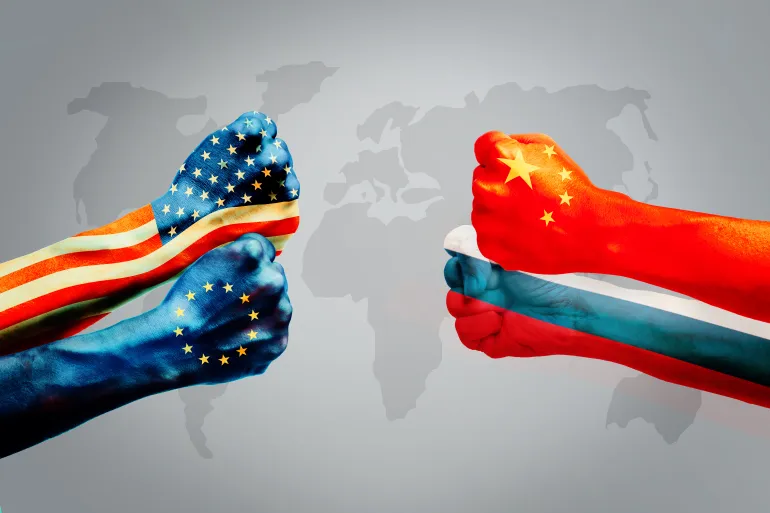
In the current landscape, three main circles are taking shape within what can be called “bloc economies,” and this crystallization is not in isolation from the growing uncertainty about the stability of traditional Western alliances. As tariff tools and political pressures become increasingly used in the management of economic relations, countries tend to reposition themselves within more predictable circles and less susceptible to geopolitical volatility, reinforcing the logic of regional and bloc alignment.
- The first is the Western bloc, which includes the United States, the European Union, Canada, Japan, and Australia, and the U.S. Congress passed the Chips and Science Act in 2022, and began its practical implementation in 2023 and 2024 by injecting tens of billions of dollars to support domestic semiconductor manufacturing.
Reuters reported on April 9, 2024, that the US Department of Commerce has tightened restrictions on the export of advanced chips to China, stressing that the move is aimed at protecting national security.
This trajectory reflects the transition of industrial policy from its traditional role of supporting competitiveness to an explicit tool for re-engineering interdependence.
- The second circle is centered around Asia, led by China, and has been strengthened by the Regional Comprehensive Economic Partnership Agreement. In a study published by the French Institute of International Relations in 2024 on the reshaping of trade patterns, French researcher Sébastien Jean explained that the data does not point to a total collapse in global trade, but rather to its reorientation within regional circles.
China continues to expand the Belt and Road Initiative and is working to diversify trade settlement mechanisms in national currencies, in an effort to reduce exposure to risks associated with the existing financial system, he said.
- The third circle is embodied in the expansion of the BRICS group, as a study published in the “BRICS Journal of Economics” in 2024 by researcher Mohamed Saeed addressed the issue of de-dollarization within the bloc.
The French researcher pointed out that the BRICS countries seek to boost trade in local currencies, but they still rely on the dollar for a large percentage of their transactions, reflecting a gradual transition in the international monetary structure rather than an immediate break with the existing system.

Restructuring supply chains
In a January 2024 article published in Asia Policy, researchers Tony Dai and Zhang S. Tang explained that the concept of “de-risking” goes beyond the idea of relocating production lines, as companies systematically assess political, logistical, and financial risks.
The researchers stressed that companies prefer to diversify suppliers even if costs rise, reflecting a shift from maximizing efficiency to maximizing flexibility.
A World Bank study published in 2025 titled “Geopolitical Fragmentation and Friendship in Reorienting Supply Chains” also showed that political proximity has become an important statistical indicator in explaining trade and investment flows.
The results showed that countries with similar political positions increase their intra-regional trade at rates higher than those between ideologically divergent countries, reinforcing the hypothesis that political alignment has become a determining factor in the allocation of resources globally.
How is reality changing?
Mexico provides a clear example of the impact of the logic of “alliances”, as in 2023 it became the largest trading partner of the United States, ahead of China.
The New York Times reported on February 7, 2024, that major U.S. companies have moved part of their operations to Mexico to reduce dependence on China. This shift reflects the adoption of a security-backed “geographic proximity” policy within the framework of value chain repositioning.
In Europe, the European Commission launched a bio-raw materials strategy in 2023 with the aim of reducing reliance on China for rare earths.
The French newspaper Le Monde reported on March 16, 2023, that Brussels is seeking to secure supply chains through partnerships with African and Latin American countries, in an effort to diversify sources of supply and reduce the concentration of risk.

In the Gulf, a number of countries are adopting strategies that are carefully balancing Chinese investments with strategic relations with the West.
Bloomberg reported on October 12, 2024, that the UAE is expanding its technology cooperation with China, while maintaining close security partnerships with the United States.
This approach embodies what Ayer and Unsorg describe as the concept of an “intermediary state,” which leverages its position among blocs to maximize its gains and reduce the costs of sharp alignment.
Macroeconomic Impacts
The IMF warns that duplication of supply chains and duplication of industrial investment could lead to inflationary pressures and rising production costs, which are reflected in global price levels.
Recent estimates suggest that the pace of trade growth between geopolitically divergent countries is slower than that of trade within politically convergent circles, reflecting a measurable shift in global interdependence.
In a paper, the Peterson Institute for International Economics asserted that industrial policies driven by national security considerations could undermine the multilateral trading system and lead to losses in global efficiency.
In contrast, some researchers argue that redistributing production may enhance resilience and reduce systemic risks. A 2023 OECD report on global value chains noted that geographic diversification can limit the impact of future shocks, albeit raise costs in the short term.
In an interview with The Guardian on January 5, economist Dani Rodrik stated that “globalization is entering a new phase where politics takes precedence over the economy,” suggesting that economic decisions are becoming more tied to geopolitical polarization.
“The world is seeing a remapping of supply chains due to geopolitical tensions,” BlackRock CEO Larry Fink said in his annual message to investors in March 2024, stressing that the shift is becoming a reality reflected in long-term investment decisions.

Are we witnessing the end of globalization?
The data does not indicate a full-blown collapse in global trade, as the 2025 report of the United Nations Conference on Trade and Development (UNCTAD) showed that trade continued to grow despite the tensions. However, the nature of this growth is changing, as “conglomerate economies” advance as an organizational pattern, and the system of “alliances” is established as a benchmark for defining strategic partners.
Economic efficiency has not disappeared, but it has lost its place as a single standard. National security considerations and technological sovereignty have intertwined with trade calculations, redefining the very concept of globalization.
The world today is moving from a globalization governed by efficiency to a globalization managed through alignment, where interdependence remains, but with clearer political conditions.
Thus, the global economy enters a phase that can be described as “strategic interdependence”, according to researchers, where countries are interconnected commercially and financially, but they reshape this interdependence through a system of alliances and blocs that redistribute risks and gains.
This trajectory can be understood as a systematic repricing of geopolitical risks within the structure of the global economic system.
The question is no longer whether interdependence will continue, but who sets its rules, and how to re-engineer its networks in a world where alignment is ahead of economic neutrality.