Analysis
Breaking News
Culture
Industry
Lifestyle
News
Opinion
Politics
Regional
Sports
Top Stories
Uncategorized
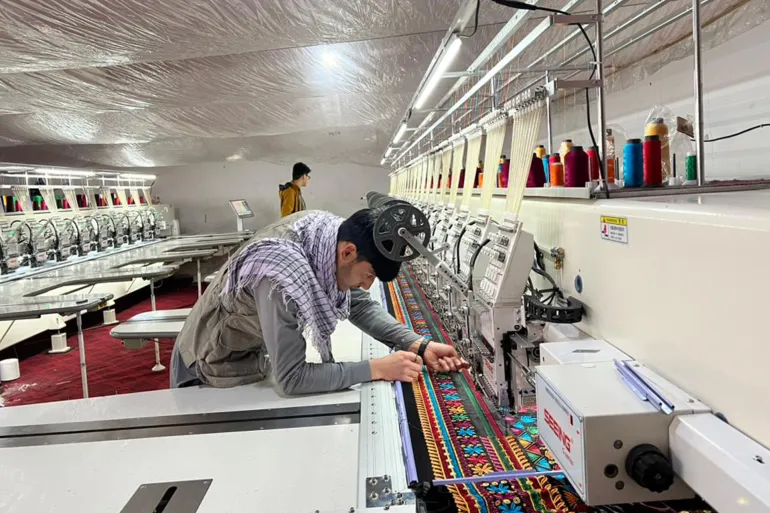
KABUL – In the industrial zone east of the Afghan capital Kabul, the sounds of machinery continue non-stop, and fabrics move between the hands of workers amid the smells of yarn and fabrics, and from within this scene, dozens of people work in a factory for the production of women’s clothing, newly relocated from the Pakistani city of Karachi, to form a new life station for a number of Afghans who have recently returned to their country after years of exile.
Moving the factory to Kabul is a step that reflects a gradual shift in the trajectory of some Afghan investments inwards, Abdul Hakim Salehi, a technical supervisor at the factory, told Al Jazeera Net, “We are not just moving a factory, we are trying to transfer a complete experience from the outside to the inside. Many of the merchants who used to work in Karachi are watching what is happening here, and if this experiment is successful, it will encourage them to come back and invest their money inside Afghanistan instead of abroad.”

The factory is not a start-up project, but is based on more than 35 years of experience, as it was active in the city of Karachi, before its owner decided to move his activity to the Afghan interior.
“We trained these workers years ago. Today, almost the entire team is made up of Afghans who have returned to their country.”
The factory employs between 80 and 100 people in the fields of machine operation, sewing and processing, as part of an integrated production process that reflects the accumulation of long experience in this sector.
Returnees and the Labor Market
Afghanistan has been witnessing an unprecedented wave of Afghan returns from outside the country for more than a year, and recent data from the UN refugee agency showed that more than 5.4 million Afghans have returned home since October 2023, mostly from Pakistan and Iran, amid international calls for urgent support.
The United Nations said some 270,000 Afghans had returned to the country since the start of the year, including 160,000 from Pakistan and 110,000 from Iran, with the flow of returnees continuing daily, despite a slight decline compared to the peak of returns in 2025.
These large numbers of returnees are doubling the pressure on the local labor market, which is mainly suffering from limited job opportunities and high unemployment rates, especially in the craft and industrial sectors, and many of these returnees arrive without savings or housing, which makes them in urgent need of stable economic opportunities.
Shoaib Ali, a factory worker, recently returned from Karachi after more than five years in the field of women’s clothing, telling Al Jazeera Net, “I returned to my country after many years in exile, and I was worried that there were no job opportunities here.” He adds that many of his friends have returned with him, but most of them have not yet found a stable source of livelihood, so having a factory like the one he moved from Karachi is a real opportunity for him and his friends to rebuild their lives.
“Working in the factory not only gives me a steady income, but also gives me a sense of stability and a sense of belonging to my country. We are involved in all stages of production, from machine operation to sewing and garment processing, which makes us part of the entire production process.”

Local Production
The factory’s goal is not only to employ returning workers, but also to boost domestic production in Afghanistan, which is heavily dependent on imports for women’s clothing.
“If we can produce locally, we will not only create jobs, but we will also contribute to reducing dependence on imports and providing products of competitive quality in the local market,” Ghausuddin Safi, one of the factory’s officials, told Al Jazeera Net.
“Every stage of production is designed to ensure quality and efficiency, and we are continuously training workers, so that they can manage all processes themselves, from prototype design to final product delivery,” Safi adds.
Production Challenges
But despite these efforts, the factory faces several challenges that are hindering its expansion, with factory officials saying securing raw materials is one of them, with some of them imported from countries such as India, Iran and China, while restrictions on transport routes through Pakistan regularly impede its access.
They add that the use of air transport, especially from India, leads to a significant rise in freight costs, which is directly reflected in the cost of production and the prices of finished products.
They also point out that power outages are an additional challenge, as it leads to the suspension of machinery and delays in production processes, which sometimes forces the factory to rely on generators, thus increasing operational costs, as it seeks to maintain competitive prices.
Government Support and Facilities
Afghan Ministry of Commerce and Industry spokesman Abdul Salam Jawad Akhundzada says the government views the return of factories and investments from abroad as an “important economic opportunity” given the challenges facing the labour market.
Akhundzadeh added in a statement to Al Jazeera Net that encouraging local production is one of the priorities of the current stage, due to its role in reducing dependence on imports and providing job opportunities, pointing out that the ministry is working to create conditions for the return of Afghan investors, expand their activity inside the country, and provide the necessary facilities to ensure the success of their projects.

Opportunity or Limited Solution
Afghan economist Nasrullah Fitr said such projects represent a “positive but limited step”, explaining in a statement to Al Jazeera Net that absorbing large numbers of returnees requires expanding the local investment base and supporting small and medium-sized industries.
Fitrat adds that the transfer of expertise from abroad to the inside can be a real opportunity for the Afghan economy, but the success of this depends on investing these expertise in an organized manner, linking it to clear policies that support local production and create a sustainable work environment for returnees.