Analysis
Breaking News
Culture
Industry
Lifestyle
News
Opinion
Politics
Regional
Sports
Top Stories
Uncategorized

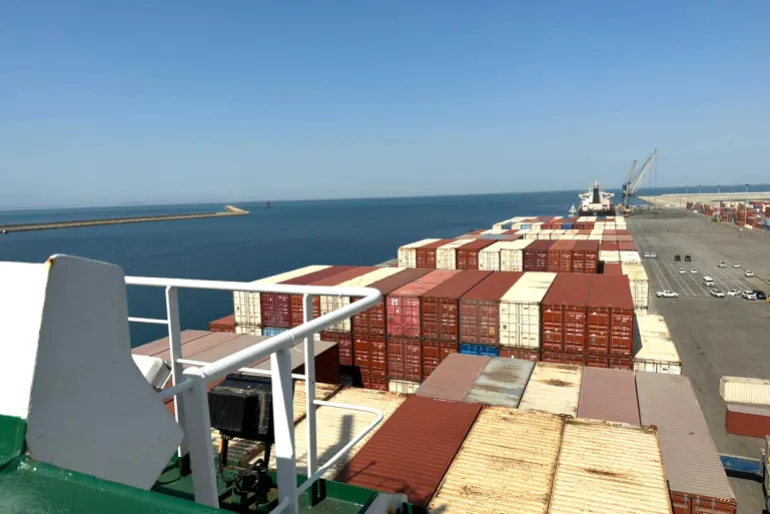
Part of the container wharf at the port of Chabahar (island)
India seeks to renew exemption of Iran’s Chabahar port from US sanctions amid blockade of Washington (Al Jazeera)
With the expiration of the U.S. deadline that allowed India to continue its work at Iran’s Chabahar port, New Delhi has reverted to moving between Washington and Tehran to avoid losing one of its most important ports to Afghanistan and Central Asia.
The port on the coast of the Sea of Oman is not just an economic project between India and Iran, but a strategic corridor that allows New Delhi to bypass Pakistan, balance China’s presence in Pakistan’s Gwadar port, and maintain its commercial influence in Afghanistan.
In a parliamentary reply dated March 19, 2026, India’s Ministry of External Affairs says New Delhi remains engaged with stakeholders to address the fallout from developments related to US sanctions on Chaphar as the conditional exemption that allowed India to continue operating at the port expires.
A Gateway That Doesn’t Pass Through Pakistan
Located in southeastern Iran, the port of Chabahar is important for India as it opens a sea and land route to Afghanistan and Central Asia without passing through Pakistani territory. This is not a logistical detail in India’s calculations, but rather a strategic one linked to its historic rivalry with Islamabad.
Through Chabahar, India can ship its goods by sea to Iran, and then transport them overland to Afghanistan and Central Asian countries. The Indian government describes the Chabahar port as a gateway for trade with Afghanistan and Central Asian countries, and its development project is a pioneering project between India and Iran in the field of regional connectivity.
The U.S. waiver crisis reveals that Chabahar is no longer just a port of trade, but a test of India’s ability to manage conflicting interests: a growing relationship with the United States, a working partnership with Iran, and a constant need for a path that is not controlled by Pakistan.
Indian contract for ten years
On May 13, 2024, India’s India Ports Global Limited signed a 10-year contract with the Ports and Maritime Organization of Iran (PCMO) to set up and operate the Shahid Beheshti terminal at Chabahar port.
The Indian government said the signing of the contract strengthens cooperation between New Delhi and Tehran in connectivity initiatives and supports the transformation of Chabahar into a regional hub for trade communication.
India’s Ministry of External Affairs says the company has been operating the port since December 24, 2018, and that India has raised the equipment purchase grant to $120 million, along with a $250 million line of credit for the development of projects related to Chabhar.
Since 2018, the port of Chabahar has handled more than 450 ships, 134,082 TEUs and more than 8.7 million tons of cargo, while Iran’s Anna news agency quoted the director of the Ports and Maritime Organization of Iran as saying that India’s $120 million investment commitment in the port has been fully realized.
New Delhi views these figures not only as a financial investment, but also as a confirmation of an Indian presence at a sensitive maritime point on the Sea of Oman, close to trade and energy routes in the Gulf and the Indian Ocean.

Why does India need a U.S. exemption?
The Chabahar complex is due to the US sanctions on Iran. In 2018, Washington granted an exception to the project, as it was related to Afghanistan’s reconstruction and economic development.
However, India’s Ministry of External Affairs clarified, in a parliamentary response, that the US State Department had cancelled that exception on September 16, 2025, and that the decision would come into effect on September 29 of the same year.
In a parliamentary response dated March 19, 2026, India’s Ministry of External Affairs says that after talks with New Delhi, Washington has issued guidelines extending Chabahar’s conditional exemption until April 26, 2026, and that the Indian government remains engaged with stakeholders to address the fallout from these developments.
New Delhi is moving along two parallel lines: negotiating with Washington to avoid exposing its operations to sanctions, and understanding with Tehran so that it does not lose its operational rights in the port.
From this angle, India is not moving in defense of Iran so much as it is defending a project that it considers part of its commercial and strategic security. The loss of Chabahar means for India the loss of an alternative outlet to Afghanistan and Central Asia, and a decline in its ability to maneuver in a region where the interests of Iran, Pakistan,China, and Russia overlap.
Maritime blockade increases port sensitivity
Chabahar’s case is no longer confined to the file of economic sanctions. With the regional escalation, the US Central Command announced in a statement published on April 12, 2026, that its forces will begin implementing a ban on maritime traffic entering or leaving Iranian ports, including Iranian ports located on the Gulf and the Gulf of Oman, as of April 13, stressing that they will not impede ships transiting the Strait of Hormuz and heading to non-Iranian ports.
Days later, US Central Command said in a statement published on April 19, 2026, that its forces had disabled an Iranian-flagged cargo ship bound for Bandar Abbas after ignoring repeated warnings, adding that since the blockade began, US forces have directed 25 commercial ships to derail or return to an Iranian port.
Here the sensitivity of the Indian position is multiplied. The port, which New Delhi wants to present as a trade and development corridor, is part of a broader landscape of sanctions and a naval blockade of Iran. This makes any Indian activity in Chabahar governed not only by the India-Iran relationship, but also by the level of tension between Washington and Tehran.

Afghanistan at the heart of the calculations
India clings to Chabahar because the port gives it a commercial and humanitarian communication channel with Afghanistan that does not pass through Pakistan.
According to a statement released by the Taliban government about Minister of Industry and Commerce Nooruddin Azizi’s meeting with India’s Minister of State for Commerce, the two sides discussed improving the use of Chabahar port, establishing dry ports in Nimroz province bordering Iran, launching regular shipping lines through Chabahar, and facilitating import and export procedures for Afghan traders at the Indian port of Nahava Shiva.
India’s Ministry of External Affairs (MEA) also said in a parliamentary response that the Afghan minister’s visit to India between November 19 and 25, 2025, confirmed New Delhi’s commitment to deepening trade and investment ties with Afghanistan.
Chabahar port plays an important role in supporting Afghanistan’s reconstruction and economic development, including the delivery of humanitarian and emergency aid, the ministry added.
In Indian calculations, Chabahar does not appear to be just an Iranian port, but part of a broader policy toward Afghanistan: maintaining an economic presence, securing an alternative route for goods and aid, and minimizing the impact of recurring tensions at Afghan-Pakistani crossings.
The shadow of China and Pakistan
Chabahar also enters the equation of rivalry with China and Pakistan. Not far from the Iranian coast, Pakistan’s Gwadar Port is part of the China-Pakistan Economic Corridor (CPEC) projects, and the official platform of the corridor is included in the Gwadar Port and Free Zone development projects.
For India, Chabahar provides a counterbalance to China’s presence in the Arabian Sea, as well as a corridor that Pakistan does not control.
New Delhi does not want to withdraw from the port, but rather seeks to rearrange its presence there in a way that protects it from US sanctions and preserves its future rights.
A port at the heart of the corridor conflict
The Chabahar case reveals that sanctions on Iran are not only pressuring Tehran, but are reshaping the calculations of other countries, especially India.

New Delhi is not acting in defense of Iran as much as it is acting in defense of its own interests: a road to Afghanistan, a gateway to Central Asia, a balancing act for China and Pakistan, and a financial and political investment that it does not want to lose.
India’s negotiations with Washington and Tehran have therefore become a test of its foreign policy. It wants to stay close to the United States, but it does not want to abandon Iran as a geographical corridor for which there is no easy alternative. It wants to avoid U.S. sanctions, but it doesn’t want Chabahar to become a stalled project after years of investment.
Ultimately, Chabahar sums up the corridor conflict in Asia: an Iranian port, Indian employment, U.S. sanctions and blockade, a Sino-Pakistani shadow, and an Afghan bet on an alternative port.
The real question is no longer whether the port matters, but whether India can keep it operating amid sanctions and regional tensions.