Analysis
Breaking News
Culture
Industry
Lifestyle
News
Opinion
Politics
Regional
Sports
Top Stories
Uncategorized

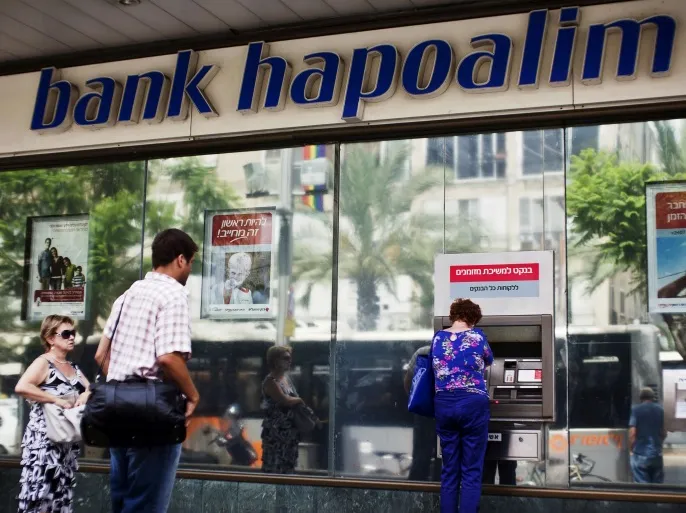
Israel’s Bank Hapoalim serves as a bridge between the Palestinian and Israeli financial systems (Reuters)
Israel’s Bank Hapoalim and Discount have informed Palestinian banks of their intention to halt vital correspondent banking services within weeks, in a move that threatens to disrupt the financing of essential imports, shift workers’ wages and expand the informal monetary economy in the West Bank.
AFP quoted unidentified Palestinian banking officials as saying that five Palestinian banks that rely on Bank Hapoalim for their messaging services will lose access to these services on August 13, while banks that carry out transactions through Discount Bank face a similar date on September 1.
The Israeli Ministry of Finance confirmed that the two banks informed it of their intention to end correspondence relations with Palestinian banks, explaining that the decision came in light of what it described as increasing public risks and fears of private lawsuits that may target Israeli banking institutions.
In a statement on Wednesday, the ministry said it was in talks with the two banks in an effort to continue banking correspondence services “in a safe and responsible manner,” while protecting Israel’s security and economic interests.
Hapoalim and Discount act as a bridge between the Palestinian and Israeli financial systems, allowing Palestinian banks to settle transactions denominated in shekels, including payments for importing electricity, water, fuel and food from Israel, as well as transferring the wages of Palestinians working inside Israel and settling foreign trade transactions.
Palestinian banks do not have direct access to Israel’s payment system, so they rely on Israeli banks as correspondent banks to carry out transfers and settle payments in shekels.

Legal risks
Every six months, the Israeli government renews letters of compensation and immunity that protect the banks from legal liability for transactions they carry out on behalf of Palestinian banks, particularly in cases related to allegations of money laundering or terrorist financing.
An unnamed Israeli banking official was quoted by AFP as saying that commercial banks no longer want to take on these risks, and that the current exemptions are insufficient and that the state should take full legal responsibility.
The official added that this arrangement was temporary from the beginning, but the risks have risen over the years, at a time when the banks fear to be exposed to lawsuits or prosecutions related to transactions that pass through Palestinian banks.
In a statement to the agency, Discount Bank said it had conveyed its concerns to the relevant authorities due to the increasing risks associated with the provision of these services and its responsibility to depositors and shareholders, while Bank Hapoalim said only that the matter was still under review.
In a May 2026 report, the World Bank warned that the uncertainty surrounding correspondent banking poses an imminent systemic threat to the Palestinian financial sector, stressing that stopping or substantially reducing them would have immediate destabilizing effects in the financial and real sectors.
The Bank explained that the Palestinian economy relies on the shekel as the main currency, and that transactions with Israel and the outside world pass through the Bank of Israel and Israeli commercial banks, and warned that the disruption of these channels could weaken the ability of banks to finance the flow of basic goods, including fuel, water and medical supplies.
Paris Protocol
The Palestinian banking sector’s dependence on Israeli banks dates back to the economic and monetary structure established by the Paris Protocol, signed between the PLO and Israel on April 29, 1994, and incorporated into Annex V of the 1995 Israeli-Palestinian Interim Agreement.
The protocol established a unified economic framework between the two sides based on a common customs envelope, kept the Israeli shekel a legal currency in circulation in the Palestinian territories, and established the Palestinian Monetary Authority to supervise banks without issuing an independent national currency.
Under this system, Palestinian banks accept deposits and payments in shekels, but they need the Israeli banking system to transfer currency surpluses, settle digital payments, and finance trade with Israel, which is the main trading partner of the Palestinian economy.
The system of clearing revenues is also based on the protocol, where Israel collects VAT and customs duties on imports destined for the Palestinian territories, and then is supposed to transfer its proceeds monthly to the Palestinian Authority after deducting an administrative fee of 3%.
But Israel has suspended the transfer of clearance revenues entirely since May 2025, according to the latest World Bank report, prompting the PA to increase borrowing from local banks, accumulate arrears and pay portions of government employees’ salaries.
Clearing revenues account for about two-thirds of the PA’s income, according to AFP, making its suspension in conjunction with the suspension of correspondent banking services a double blow to public finances and the payments system.
Interdependence of banks and power
Experts warned that severing banking links could push more transactions into cash circulation, increase the risk of money laundering and expand the informal economy, as well as the potential for a liquidity crisis within Palestinian banks.
A Palestinian businessman with close ties to a local bank, whose identity was not revealed, said the PA is the largest borrower of local banks because it relies on them to finance public sector salaries and budget deficits, warning that the collapse of the banks will threaten the survival of the PA itself.

The World Bank’s data show the extent of this correlation, as the Authority’s direct borrowing from local banks reached about $3.3 billion by the end of 2025, while the total exposure of the banking sector to the public sector, including loans to the Authority and government employees, reached about $5.3 billion, equivalent to 42% of total bank credit.
The impact of the severance of ties may not be limited to transfers between banks, but also extends to the PA’s ability to pay salaries and finance public services, and the ability of Palestinian companies to import basic goods and settle their payments with Israeli and foreign suppliers.