Analysis
Breaking News
Culture
Industry
Lifestyle
News
Opinion
Politics
Regional
Sports
Top Stories
Uncategorized

Inflation in Iran jumps to highest level since World War II (Al Jazeera)
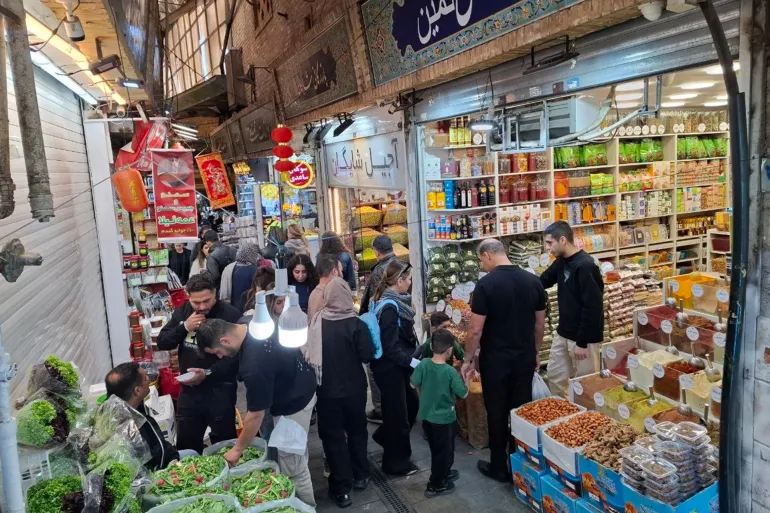
TEHRAN (FNA)- In the popular Bastan market west of the Iranian capital, Tehran, where the smells of fresh bread and fruit mingle with fabric and clothing, the scene is no longer its usual joy, with passers-by’s eyes wandering between vendors’ stalls and hands cautiously flipping goods and putting them back in their places, while “daily shopping trips have turned into something like a reconnaissance mission to find out the new prices,” said Mashhadi Firouz, a 63-year-old retiree who recalls his youthful days on the street when it was lively.
Standing in front of the shelves of a large food store, Fairuz is turning the goods one by one looking for the prices listed on their packaging, telling Al Jazeera Net: “A year ago, a kilo of rice was about 1,800,000 riyals (the dollar is equivalent to about 1,730,000 riyals), but today it has exceeded the threshold of 5 million riyals, and a bottle of oil was about 700,000 riyals until the spring of last year, but its price has now reached more than 3 million riyals.”
“My pension is not enough for a third of the expenses of the house, we are witnessing a frightening expansion in the area of poverty, and not only extreme poverty, but also what can be called the poverty of retirees and employees, where those with fixed incomes live below the threshold of destitution for the first time in decades,” he continued, adding: “We do not only complain about the high prices, but also about its speed that does not leave us a chance to catch our breath.”

High prices eat away at purchasing power
Just a few hundred meters away, Fatima, a 46-year-old housewife and mother of three, told Al Jazeera Net: “I go to the market three times a week instead of once, not because I need anything, but to see if there is a seller who has goods at a lower price, or a commodity that has not yet been hit by the wave of high prices. Red meat has become a dream, chicken has become a guest at our table, and even eggs have become a grain.”
Speaking to Al Jazeera Net, she explained that talking about doubling prices in days or weeks is no longer strange, adding that inflation is no longer an earthquake that hits everyone equally, but rather a selective class epidemic that kills the weak the most than others, as when the price of food rises, the poor family loses half of its income due to necessities that it cannot do without, while the rich family feels only a slight scratch in its well-being.
At a wholesale market in Naranj, south of Tehran, 71-year-old Haj Mehran, a food merchant, spoke of another side of the crisis, saying, “Inflation has not only hit the buyer, but also us. Purchasing power has collapsed, and people are buying only necessities. Prices have doubled in less than four months, so we have had to reduce the quantities offered, but we can’t find anyone to buy them.”
Speaking to Al Jazeera Net, he adds, “In my 40 years of work, I have never seen a recession this bad, even in the worst periods of sanctions.”
Regarding the impact of his profits, he says, “I am not looking for a big profit at the current stage, I am just trying not to go bankrupt and close the shop that I inherited from my father.”
Deceptive congestion
From there to Tajrish Square, north of Tehran, where its popular market seems crowded with customers at first glance, but the shopkeepers tell a completely different story:
“The crowd you see is deceptive, you count the market alive but clinically dead,” says 47-year-old Reza (a shop owner) on the shopping traffic in the market.
He adds to Al Jazeera Net: “People come here because the market has become the last free place for entertainment, they wander aimlessly, they remember the days when they used to enter shopping malls and come out with bags that filled the trunk of the car. Today, they may not buy anything, and I don’t blame them, I personally as a merchant, I can no longer buy what I sell.”
Reyhana, a 32-year-old accountant in a private company, said: “Every day I pass by here, and I make sure to buy something, but I feel sad when I see people walking around in the hundreds with their hands without bags. They didn’t come to look at the prices, but many of them leave when they hit very high prices.”

Her husband, Mahmoud, 37, a teacher at a private university, then picks up on the conversation and tells Al Jazeera.net: “You may hear here about inflation exceeding 300% for some goods, and you think it is an emergency shock caused by the war, but the truth is that these numbers would not have been possible without structural diseases accumulated by decades of dependence on oil revenues, the country was covering its wounds with petrodollars, and now that the drug has dried up, all the ills have appeared at once.”
Looking at the shelves full of goods, Mahmoud adds, “What worries me is not only the rise in prices, but the experts’ estimates of the consequences of wrong economic policies that have not yet emerged, because they are already hidden behind the noise of war. This means that we are standing on the edge of an iceberg, what we are seeing now is only the top,” he said, adding: “What makes matters worse is that we are stuck in a state of no war and no peace and this state of suspension is the worst poison that can infect a debilitating economy.”
Hyperinflation
A recent report by the Central Bank of Iran revealed a historic jump in the annual inflation rate, which reached 77.2% year-on-year between April 21 and May 20, with a monthly increase of 8.5% compared to the previous month, and point inflation for goods reached 113%.
With these figures, Iran has recorded its highest inflation since 1942, during World War II, when military unrest caused food supply chains to collapse and prices skyrocketed.
Although official authorities have not addressed the historical significance of these high inflation rates, Arman Khaleghi, president of the Iranian House of Industry, Commerce and Mines, points to what he described as a “complete economic storm” of five intertwined factors that simultaneously focused on the already debilitating body of Iran’s economy.
Speaking to Al Jazeera Net, Arman Khaleqi said, “What happened in prices cannot be attributed to one reason, as we are facing a fatal overlap between the deletion of the preferential currency (the subsidized exchange rate for the provision of basic commodities) that blew up the prices of food commodities, and the protests that the country witnessed at the beginning of this year that disrupted the market system and disrupted the country’s security, and then came the Ramadan (American-Israeli) war, which is not without devastating inflationary effects, followed by annual increases in wages and energy prices at the beginning of the year The new Iran, and finally the naval blockade that disrupted import and export chains.”
Causes and repercussions
As for the impact of the war in particular, Khaliqi believes that it was not just a military shock, but a “panic demand engine” that radically changed the behavior of consumers, explaining that “with the outbreak of the war, people rushed to stock basic commodities such as food and detergents, and demand jumped hysterically despite the lack of real shortages in the markets, and this frantic demand alone is enough to raise prices.”
However, according to Khaliqi, the matter did not stop at the demand limits, but extended to the production shock, as the damage caused to the parent industries, especially petrochemicals, was reflected in the costs of packaging materials for the food, pharmaceutical and detergent industries, and the problems of the steel sector returned to hit the automotive and home appliances sectors, according to him, which transferred the contagion of inflation from the factory to the store shelf.

Khaleqi points to an external factor that was the “knockout blow”, namely the naval blockade that made the arrival of ships bound for Iran a risky task, and he says in this regard: “Even the mere news of a ship being targeted immediately raises prices, let alone the actual difficulties and tangible shortages that prompted the search for alternative and more expensive land routes, which put the import process in a dark tunnel and spread in the market a sense of coming scarcity that translates itself into a flame in prices.”
With regard to the figures, Khaliqi addresses the paradox of the increase in salaries and workers’ wages at the beginning of the year, in exchange for inflation that exceeded all official expectations, revealing the hidden tragedy by saying: “The decision to raise wages and salaries was aimed at compensating for the effects of the removal of the preferential currency and preserving the purchasing power of the working class, but the increase that seemed significant on paper has become completely insufficient in the field, and the result is a sharp decline in real purchasing power, which begins first by devouring the family’s savings, and then pounces on the items of health, treatment and education. so that he can make a living on a daily basis.”
Khaliqi warns of a vicious circle in the economy, saying, “We are in a situation where the country itself is under the weight of an economic slowdown, and tax revenues that were supposed to offset part of the cost of preferential currency reforms are also shrinking. Thus, we are faced with an impossible equation: the income of the citizen is melting, the income of the state is eroding, and prices continue to soar in a sky that we have not known for decades.”