Analysis
Breaking News
Culture
Industry
Lifestyle
News
Opinion
Politics
Regional
Sports
Top Stories
Uncategorized

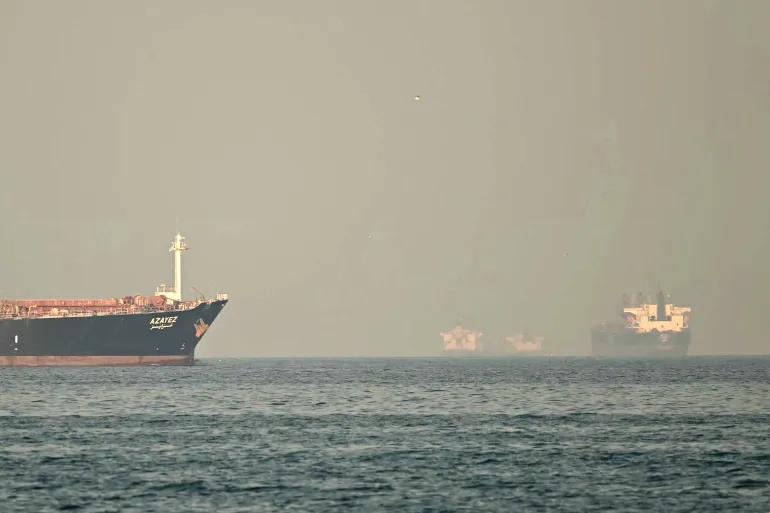
Ships and oil tankers in the Gulf (French)
The market expects a further wave of oil price ups after major production shutdowns that began in Iraq and may spread to other countries after they deplete their crude storage capacity, according to the Financial Times.
JPMorgan analysts estimated that there would be a slightly longer margin before the lack of storage capacity led to production shutdowns, but said more than 3 million barrels of oil would be withdrawn from the market by Sunday, rising to around 5 million barrels if the conflict drags on for two and a half weeks.
On Tuesday, Iraq became the first major exporter to start cutting production, announcing that it had begun cutting output in three of its largest oil fields.
The Financial Times quoted a major oil trader as saying that Iraq’s production loss exceeded 2 million barrels per day, with an additional 1.5 million barrels per day threatened “over the next two days.”
Other fields across the region are expected to close in the coming days, drawing millions of barrels of crude off the market, unless energy shipments can resume transit through the Strait of Hormuz.
New targeting
Iran’s Islamic Revolutionary Guard Corps (IRGC) said in a statement broadcast by state media on Thursday that it targeted a US tanker in the northern part of the Gulf and that the ship caught fire, adding that in wartime the passage through the Strait of Hormuz would be under Iran.
According to the Financial Times, there are estimates that Saudi Arabia may have no more than two weeks to close the strait before it has to cut production.
Saudi Arabia, the world’s largest oil exporter, has the largest storage capacity in the region, but satellite imagery suggests some of its facilities are under pressure.
The newspaper quoted an oil trader who predicted that Kuwait would resort to halting production of another 1.5 million barrels in the next three days, and said: “Kuwait is the next to be monitored, it will retreat quickly, it is in the same logistical situation.”
“After that, the UAE will be affected over the next five days, and then when we reach 15 days or more, part of Saudi Arabia’s production will start to be lost,” he added.
On Tuesday, U.S. President Donald Trump offered to provide a marine escort and additional insurance to encourage oil tankers to make the trip, but did not specify when the measures would be implemented.
Oil continues to rise
Oil prices continued to rise, with Brent crude up 2.7% to $83.60 at the time of writing, while U.S. crude rose 1.19% to $77.03.
The crews of oil and gas tankers stranded in the Gulf are now conducting daily firefighting drills, with sailors wearing firefighting suits, protective masks and oxygen tanks, and practicing the use of hoses and fire extinguishers in a range of simulated emergency scenarios, including fires on the roof, bridge and engine room.
The drills became more important when Iran began attacking ships near the strait, prompting the crews of the targeted ships to rush to extinguish the fires and contain the damage to their ships.
At least 11 ships have been attacked, including three on Tuesday evening, and an attack on an oil tanker on Sunday by a remotely operated boat killed an Indian sailor.
It pointed out that about 3,000 ships are stuck in the Gulf following the closure of the Strait of Hormuz.