Analysis
Breaking News
Culture
Industry
Lifestyle
News
Opinion
Politics
Regional
Sports
Top Stories
Uncategorized

Questions are raised about Trump’s ability to carry out his economic threats against Iran and its partners
U.S. President Donald Trump has expanded his economic threat to Iran to include any country or entity that gives Tehran what he described as a “lifeline,” vowing “enormous economic consequences” for those who help it export oil or keep its financial and trade channels open.
But Trump did not name a specific country, nor did he explain how his threat would translate into actions, despite the breadth of his circle, from oil smuggling and money transfers to exchange companies and front companies. According to Reuters, the circle is expanding to include even Washington allies who helped broker peace talks between Washington and Tehran.
This is where the dilemma begins: Tools that might work against an oil tanker or front company become more complex and costly when the target is a large Chinese bank or an ally that relies on Iranian gas.
Penalties and fees. What does Washington have?
Washington has a wide range of lobbying tools targeting oil tankers, front companies, refineries, shipping companies, and foreign banks.
But as the targeting moves from a company or carrier to a large bank or country, the cost rises and the calculations become complicated.
Since the start of Trump’s second term, the U.S. Treasury Department’s Office of Foreign Assets Control (OFAC) has sanctioned more than 1,000 people, ships and aircraft, including those linked to Iran’s oil fleet and shipping insurance companies.
The most prominent of these tools is “secondary sanctions,” which may put foreign companies and banks with two costly choices: continue to do business with sanctioning Iranian actors, or risk losing access to the U.S. financial system.
International law and trade law specialist Shantanu Singh sums up this capability by telling Al Jazeera that what the US president can do is “impose unilateral sanctions, disrupting the use of US financial institutions in international trade with Iran”.
But the new threat goes beyond businesses and banks. Trump has previously tried to transfer the pressure to the level of the countries themselves, by imposing tariffs on the products of those who continue to do business with Iran, raising the cost of their goods entering the American market.
That attempt failed after the Supreme Court overturned the legal basis on which it was based, without prejudice to existing financial penalties. But the tariff door was not closed for good, as the Senate later passed a bill giving the president new customs powers and is still awaiting House approval.
What Washington intends to do this time is not yet clear; however, its toughest test will be in China.

China. The toughest test of sanctions
China is the largest buyer of Iranian oil, so it is hard to imagine a real tightening of the noose on Tehran without getting closer to Beijing.
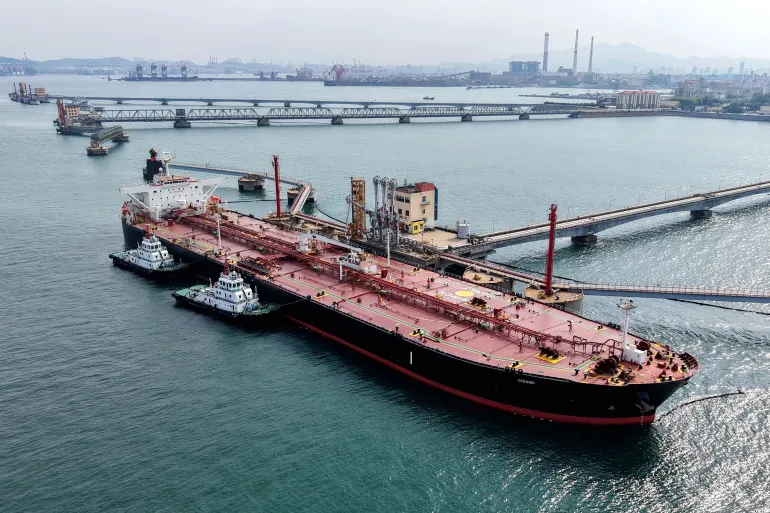
According to Kepler’s data, more than 80% of Iran’s sea-charged oil has gone to China, which bought an average of 1.38 million barrels per day in 2025. The U.S. Treasury Department estimates that China buys about 90 percent of Iran’s total oil exports.
Reuters says most of that goes to independent refineries known as “teapots,” part of a semi-isolated system China built over the past decade to refine Iranian oil, which has little exposure to the United States. According to the agency, the crude passes through hard-to-trace intermediaries and is settled in yuan, while its originator is sometimes reclassified as Malaysian and, more recently, Indonesian.
When Washington tried to break this cycle, the response came from Beijing. After imposing sanctions on the Hengli refinery in Dalian, China, which the U.S. Treasury described as one of Tehran’s most important customers, China’s Ministry of Commerce issued an order stating that U.S. sanctions on five refineries “shall not be recognized, enforced, or complied with.”
But moving from refineries to banks raises the cost even more.
Reuters says the Treasury “warned two major Chinese banks that they could be subject to secondary sanctions if Iranian money is found moving through their systems,” but stopped short of warning and did not include them on sanctions lists.
Sanctions experts tell Reuters that targeting the two banks could have a “deterrent effect” on larger financial institutions, but could also call for “retaliatory measures from Beijing.”
U.S. officials also fear that China will curtail exports of critical metals needed for high-tech industries.
China is not just a major outlet for Iranian oil, but it is also a party that is difficult for Washington to pressure without calculating the cost of responding.
$9 billion in the shadow network
But pressure on China alone does not close all outlets, as Tehran relies on a wider network of exchange firms and financial interfaces.
According to an analysis published by the Financial Crimes Network Vincen in October 2025, about $9 billion of potential Iranian shadow banking activity passed through U.S. correspondent accounts in 2024, including about $5 billion through companies that exist only on paper, and $4 billion through oil companies suspected of being Iranian facades.
And with each channel that closes, another appears. Sanctions expert Brett Erickson likens the hunt to a game of “hit the mole,” saying Tehran is “creating new entities to replace the old.”
The use of the Chinese yuan does not completely eliminate the dollar’s strength, as according to a Carnegie Endowment study, Tehran-linked networks are re-converting part of their revenues into dollars and euros. In other words, Iran and China have built a path around the dollar, but they have not yet built a financial world that they do not need.

When Pressure Reaches Allies
The “any lifeline” equation is even more difficult when some of these arteries pass through countries that are connected to Washington itself.
Iraq, whose trade with Iran exceeded $10 billion in 2025, pays about $4 billion to $5 billion a year for Iranian gas used to generate electricity.
Two Iraqi energy officials told Reuters that any new U.S. sanctions “could create significant challenges for Baghdad” to continue paying for Iranian energy without being sanctioned.
In Turkey, trade with Iran amounts to about $5 billion to $6 billion a year, and Tehran provides 13 percent of Ankara’s gas imports.
The UAE, which was one of Iran’s largest trading partners before the war, providing 30 percent of its imports in a $21 billion trade in 2024, has taken a different path, announcing this week that it will suspend its economic and financial dealings with Tehran until further notice.
Thus, in all cases, “lifelines” do not mean political support for Iran; in some cases, the issue is related to electricity, gas, or trade that is difficult to cut off by a single decision.
Where does the power of sanctions go?
In Tehran, Foreign Minister Abbas Araqchi called Trump’s threat “a distraction from America’s own crisis: unprecedented debt and rising interest costs,” and said that “U.S. economic terrorism threatens the global economy and the national sovereignty of the countries of the world.”
Beijing’s response has been less harsh and more explicit in its rejection of the principle. Foreign Ministry spokesman Lin Jian said that “sanctions and pressure will not solve the problem,” calling for it to be addressed “by political and diplomatic means.”
Frederick Schneider, a researcher at the Middle East Council on Global Affairs, summed up the dilemma by telling Al Jazeera that sanctions “raise the cost of trade with Iran, but they can’t end it.”
Washington does not need to close every port to Iran in order to make sanctions painful, but it is enough to make them more expensive and more difficult to finance and transport.
But whenever the pressure shifts from a tanker or front company to a large Chinese bank or a country that relies on Iranian energy, it is no longer just a question of the cost Washington can impose on others, but also the cost it can afford.