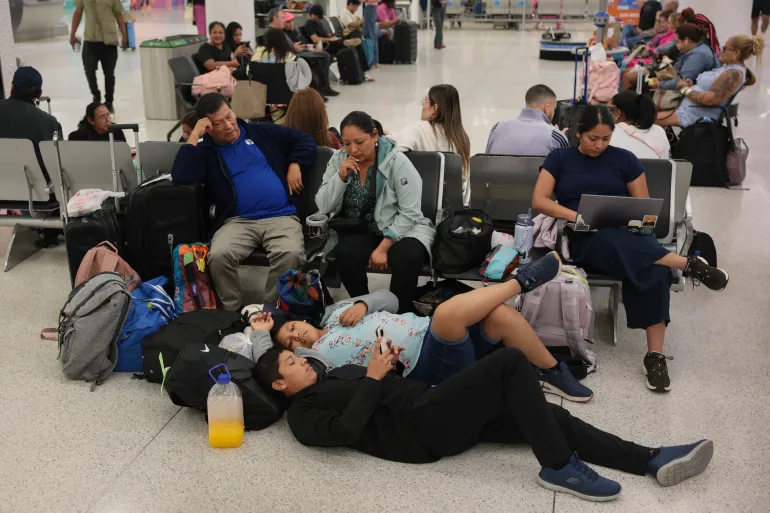
Planes are resuming take-off in the United States after a major pause on Friday, but the reopening of the skies does not close the bill for the crisis: Airlines are faced with rearranging planes, crews and bookings, while travelers consider what expenses can be recovered and what they will pay out of their own pockets.
More than 4,700 flights were cancelled and another 10,000 delayed on Friday, November 13, and about 700 additional flights scheduled for Saturday had already been cancelled, according to FlightRadar24 data quoted by Reuters, which shows the extent of the operational disruption but does not disclose financial losses.
The FAA said communication issues that affected several air traffic control centers prompted it to issue a blanket take-off halt, and the decision was lifted Friday evening after more than four hours, with warnings that it would take time for traffic to resume.
According to Sky News, the carriers’ statements reveal that restoring operations carries burdens beyond repairing the malfunction itself, with Delta explaining that reconfiguring its operations requires repositioning aircraft and crews, while Alaska said it had cancelled flights and diverted others, and that a return to the operating schedule would take time after the shutdown ended.

U.S. Airlines Flights Completely Halted During Crisis
JetBlue announced the cancellation of flights on Friday evening, excluding flights departing to Europe, and allowed exempt passengers to rebook for travel until November 18 without change or cancellation fees and fare differences, according to its terms.
Delta announced an exemption for affected flights on November 13 and 14, allowing rebooking within a window ending on November 21, with an exemption from fare differences when conditions are met, including travel in the same cabin.
The potential bill is distributed over refunds for flights that will not be carried out, restoration costs, and passenger service and rebooking, but the value of canceled flight tickets cannot be counted as a final loss, as those who accept travel later postpone receiving the service, while choosing a refund will result in a refund.
Cancellations may also save some of the costs of the unfulfilled trip, in exchange for additional recovery expenses, which means that estimating the net financial impact needs corporate disclosures, not multiplying the number of cancelled flights by the average ticket price.
For a passenger, the value of the ticket may only be part of the loss, if they have to stay overnight, purchase an alternative mode of transportation or lose a pre-paid booking.
The U.S. Department of Transportation clarifies that a traveler is entitled to a refund when their trip is canceled or substantially altered, if they do not accept the modified or alternative trip, travel credit, or other alternatives offered. This includes tickets that were originally sold as non-refundable.
This right exists regardless of the reason for the cancellation and, therefore, the occurrence of an air traffic control defect outside the control of the airline does not exempt the carrier from refunding the money due to those who choose not to continue the journey and do not accept alternatives.
However, refunding the price of a service that the passenger did not receive is different from compensating for lost time or additional expenses, and the ministry clarifies that each company has its own policies in the services and compensation it provides in case of delays and cancellations, and that it can hold carriers accountable for fulfilling the commitments contained in customer service plans.
Therefore, announcing a free rebooking does not automatically mean that the hotel, meals and transportation will be charged, and the offer of a travel voucher does not negate the right of an eligible passenger to choose a refund instead of accepting it, according to the Ministry of Transport.

Planes parked at a US airport during the crisis
In Delta’s U.S. expense reimbursement policy, requests for reasonable expenses for meals, accommodation, and transportation to and from the hotel may be made in the event of specific disruptions within its control, but expressly excludes expenses caused by air traffic control delays.
Delta’s exceptions also include lost fares, certain prepaid expenses, alternative transportation to the final destination, and the cost of missed connecting tickets to other companies, so that the passenger may recover the unused portion of their ticket, while other elements of the cost of their disruption remain uncovered under this policy.
American Airlines, on the other hand, stipulates that the traveler bears the hotel, meals, and other expenses when the delay is beyond its control, and in return, undertakes accommodation arrangements in specific cases when the disruption is its responsibility, with conditions relating to the passenger’s accommodation, room availability, and agreement on expenses.
The reason for the external malfunction does not stop all obligations of the carriers to passengers, as according to the rules of waiting on the ground of the airport, food and water must be provided within two hours of the start of the onboard waiting, except when safety or security considerations prevent the provision of them, with the availability of valid toilets and the necessary medical care.
For flights departing from U.S. airports, the rules require companies to start moving the aircraft to a safe disembarkation location 3 hours before the passage of 3 hours for domestic flights and 4 hours for international flights, with specific exceptions related to safety, security, and air traffic control.
These obligations further complicate stagnation management, as companies must combine waiting for permission to take off, taking care of passengers, and arranging disembarkations and restarts, depending on the actual conditions at the airports.

Elderly man waits for his flight during the crisis
FedEx has said it is prepared to put contingency plans in place to reduce service disruption and will resume normal flight operations as soon as the FAA allows, adding the possibility of shipment delays to the passenger travel disruption bill, without an estimate in this statement of the magnitude of the loss.
The Federal Aviation Administration (FAA) announced that the Air Traffic Control Modernization Project received a $12.5 billion funding boost, while a report by the Government Accountability Office stressed the need for cost and schedule planning for modernization efforts. These are funds to invest in the system, not an estimate of the losses of the last stop.
Between the restoration of schedules, refunds, and the limits of covering expenses, the bill for the crisis is distributed among more than one party, as companies are responsible for implementing their obligations and restarting their networks, and travelers may bear expenses that are not covered by the sponsorship conditions, while the government is faced with the question of the cost of building a system that is more capable of preventing the recurrence of disruptions.