Analysis
Breaking News
Culture
Industry
Lifestyle
News
Opinion
Politics
Regional
Sports
Top Stories
Uncategorized

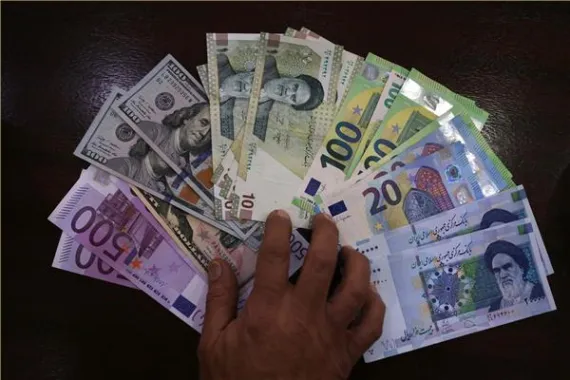
International sanctions and economic pressures have pushed Iran’s currency to lose more than a third of its value against the dollar in a year.
The Iranian rial is no longer just a currency whose value is determined by inflation, reserves, interest rates, and the movement of trade, but has become one of the battlefields themselves. With every military strike or threat of new sanctions, the exchange market is shaken, and with every financial channel Washington closes, Tehran is looking for another outlet, from China to gold, cryptocurrencies, and parallel banking networks. The question has gone beyond how much the rial has lost against the dollar to a more fundamental question: Is it still possible to talk about a traditional monetary policy in a country where considerations of war and security survival have taken precedence over the usual economic calculations?
This is the approach from which economic researcher Bassem Mohammad Abbas’s study, published by the Al Jazeera Center for Studies, entitled “The Economy of War in Iran: Monetary and Fiscal Policy in the Face of Sanctions and the ‘Economic Downturn’.” It puts the Iranian currency at the center of an escalating economic confrontation between Tehran and Washington, tracking what has happened since the war broke out on February 28, 2026, how Iran has tried to contain its effects, and how well the tools it has developed over the years to circumvent sanctions are still working.
The study does not view the collapse of the rial as a monetary story separate from the war, but rather as a mirror of what is happening in the Iranian economy as a whole. President Donald Trump described the new economic campaign in August 2026 as “Economic Landing Day,” borrowing the name of the Allied landings in Normandy during World War II, in reference to the scale of the economic attack on Iran, while the U.S. Treasury Department dubbed its campaign “Operation Economic Castaway,” in an effort to tighten Iran’s isolation from the international financial and trading system. The campaign aimed not only at adding new sanctions, but also hitting the outlets Iran had built to resist financial isolation, particularly trade with China, gold, and cryptocurrencies.
War enters the exchange market
Real Madrid were suffering before the war, but what changed after it broke out was the speed of the deterioration and its direct correlation to the pace of military escalation. The figures show the scale of the shift: on August 23, 2026, the dollar crossed the 2 million riyal mark for the first time, then rose to 2.05 million on August 27, to 2.2 million on September 2, before reaching 2.359 million riyals on September 12.
The exchange market is no longer only moving in response to traditional supply and demand indicators, but has also become highly sensitive to news from the war fronts and sanctions.
The study identifies two factors behind this behavior. The first is psychological, as every military escalation or the threat of new sanctions pushes individuals and markets to seek refuge away from the riyal. The governor of the Central Bank, Abdel Nasser Hemmati, acknowledged the role of “psychological factors and the prevailing atmosphere” in the currency’s decline. The second factor is more structural: secondary sanctions are no longer just targeting Iran’s economy in its traditional form, but are specifically chasing the channels Tehran uses to obtain hard currency outside the sanctioned banking system.
The central bank thus faces a dual problem: it has to defend the rial at home, while the dollar’s own sources are under pressure abroad.
Tehran has tried to use its own tools. The central bank has announced its readiness to inject up to $2 billion into the exchange market, said it had secured about $18 billion in foreign currency since the beginning of the year to finance imports of basic goods, medicines and raw materials, and added about $4.5 billion to foreign reserves since the start of the war. Multiple exchange rates have continued, restrictions on the withdrawal of hard currencies have been imposed, and official exchange platforms have been used to try to reduce free market pressure.
But the problem has moved from the price of the dollar to the prices as a whole.
In August 2026, point-to-point inflation was 84.4 percent, according to the Central Bank, and 89 percent according to the Statistical Center of Iran. The study does not see a contradiction in the difference between the two figures, because the central bank measures urban areas, while the other indicator includes urban and rural areas. But the message is the same: The economy is experiencing an exceptional level of price pressures, and Iranian officials have reported that food inflation has exceeded 120%.
In other words, the collapse of the currency is no longer a number on the money exchange screen; it has moved to the purchasing power of Iranians and to the cost of food and daily life.

Tehran Seeks Dollar Out of Dollar
If the sanctions are aimed at depriving Iran of hard currency, the Iranian response has been based on trying to build an economy that is at least partially able to operate outside the channels controlled by Washington.
China is at the forefront of these channels. It alone accounted for more than 80% of Iran’s seaborne oil exports in 2025, at a rate of about 1.4 million barrels per day. But this dependence carries a clear weakness within it: when one country becomes the largest buyer, the Iranian economy becomes more vulnerable to any pressure on that buyer.
China’s imports of Iranian oil fell to 785,000 barrels per day in June 2026 and then to just about 534,000 barrels in August as U.S. controls on China’s independent refineries tightened.
But the problem is not just in the amount of oil sold.
Part of Iran-China trade is done through barter: oil for goods and services. The study, based on Stanford University’s Iran 2040 project, indicates that barter accounted for 32 percent of Iran’s oil exports in the 2025-2026 budget, with it expected to rise to 41 percent in the next fiscal year.
Barter allows Iran to get its needs without going through the traditional financial system entirely, but it creates a cruel paradox: Iran can sell its oil without necessarily getting the foreign liquidity it needs to defend the rial.
Hence, the ability to sustain trade is different from the ability to solve the currency crisis.
Even the dollar, which sanctions are trying to keep away from Iran, sometimes finds its way through parallel banking networks. The study cites a Wall Street Journal investigation, based on data from the U.S. Financial Crimes Enforcement Network (FinCEN), that about $9 billion of Iran-related funds passed through correspondent accounts in U.S. banks during 2024, including about $5 billion linked to foreign front companies, and about $4 billion linked to dozens of foreign oil companies that the network estimated to be Iranian façades.
This case reveals one of the paradoxes of sanctions: the United States can restrict Iran’s access to the financial system, but controlling every dollar that passes through a huge global financial network is even more difficult.
That’s why Washington has moved from prosecuting the Iranian state to prosecuting intermediaries, accounts, companies, and banks it suspects of using them to circumvent sanctions. The study cites an example from August 2026 of Banque Misr’s branch in the UAE, which the U.S. Treasury Department said processed about $1.8 billion for 103 companies potentially linked to Iran’s shadow networks between January 2024 and June 2026.
The battle thus shifted from blockading Iranian banks to chasing the network that arose around the blockade itself.

Gold and cryptocurrencies. Sanctuary turns into a battlefield
Tehran has not placed all its bets on China. Gold has a different function: it can hold value away from the dollar and the international banking system, which is why its importance has increased as sanctions intensify and the rial deteriorates.
The numbers show the magnitude of the shift. Iran imported more than 100 tons of gold worth more than $8 billion during the Iranian year ending March 20, 2025, equivalent to about 11 percent of its total imports that year. It also imported about 43 tonnes of bullion worth $2.5 billion in just six months of 2024, a six-fold increase compared to the same period last year.
Gold fever has moved inland. The price of a gram of 18-carat gold reached 241.8 million riyals, while the refined bar exceeded the barrier of 1.05 billion riyals, and the value of the full gold track “Emami” reached about 2.41 billion riyals.
But gold is not a complete substitute for the dollar, it is less liquid, and it alone cannot fill the hard currency gap.
This is where cryptocurrencies come into play.
For Tehran, it is a way to move money away from the traditional banking system, and for some Iranians, a way to protect savings from currency collapse and inflation. The study presents a journalistic investigation of a remittance network linked to cryptocurrency platforms and Persian-speaking gambling sites estimated the amount of money passed through them at least $4 billion. However, it clearly has reservations about some of the allegations made in the investigation, pointing to the denials of Iranian authorities and the lack of independent judicial rulings on them.
More important is what happened next: the sanctions moved to the crypto space itself. In June 2026, Washington targeted the platforms Nobitex, Alex, and Pitpin, and in August the sanctions were expanded to include Chilbit and its founder.
This is where the confrontation comes into its most complex form: the cryptocurrency, which emerged as a route to escape sanctions, has itself become a target of sanctions.
The problem goes beyond the Iranian government, as some citizens use these currencies to hedge against inflation and the collapse of the rial. Narrowing this channel could simultaneously hit networks that Washington is seeking to disrupt and the savings of individuals seeking to protect what is left of their money’s value.

The decision is not in the hands of the Central Bank
Six months into the war, the study does not see Iran as having found a “solution” to its monetary crisis. What it has done is build a network of means of resistance: oil to China, barter instead of cash transfers, gold instead of some traditional reserves, cryptocurrencies and parallel banking networks instead of the closed banking system.
But every road has a roof.
Barter provides goods but does not necessarily provide liquidity, gold preserves value but is limited by the volume of demand for hard currencies, cryptocurrencies are vulnerable to prosecution, and financial shadow networks have become a direct target of secondary sanctions. At the core of its analysis, the study therefore describes these tools as means of mitigating the impact of the crisis rather than structural solutions.
Hence, three paths are determined for the riyal.
The first is the continuation of the current situation: a war that escalates and then calms down, an unstable truce, and sanctions that are gradually tightening. In this case, the rial continues to erode in stages, punctuated by sharp declines as the war escalates, but without the currency necessarily losing its full function.
The second is a political and negotiated détente that allows for gradual sanctions relief, at which point the currency can regain some of the confidence, provided that the détente is linked to clear political guarantees.
The third is worse: an all-out and sustained war coupled with the closure of China’s remaining ports, cryptocurrencies, and more. It could then go beyond an exchange rate collapse to a deeper change in the nature of the economy, with the potential for informal “dollarization” in everyday transactions.
Eventually, the study returns to the rial from which it started, but after it becomes clear that it is no longer just a subject for the central bank.
Iran’s economy can maneuver, invent new channels, buy gold, trade oil, use alternative financial networks, and intervene in the exchange market, but all of these tools operate within a space defined by war and sanctions.
This is why the study reaches a conclusion that is perhaps more important than all the dollar and inflation figures: Iran is not managing monetary stability in the traditional sense, but rather managing a protracted monetary crisis. The fate of the rial is more tied to the course of the war itself than to what the central bank can do.