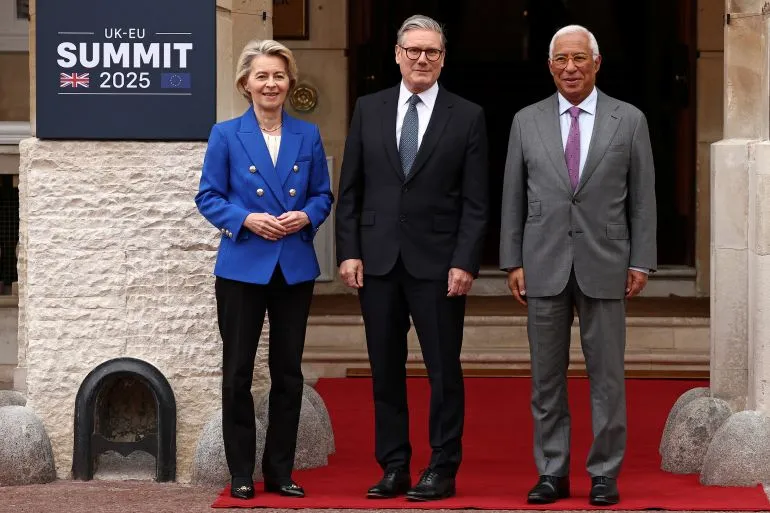
British Prime Minister Keir Starmer announced a “landmark agreement” with the EU, laying the foundation for closer cooperation with the EU.
Nearly nine years after Britain voted to leave the EU, the new deal includes a new security and defense agreement, reduced restrictions on British food exporters and tourists, and a controversial new fisheries agreement.
Britain said restarting the trade agreement with its largest trading partner would reduce red tape for agricultural producers and lower food prices. The agreement will also improve energy security, adding nearly £9 billion ($12.1 billion) to the UK economy by 2040.
Although Starmer promoted the deal as a “win-win”, the opposition Conservative Party immediately attacked, saying it would make Britain a “rule recipient” in Brussels.
Nigel Farage, leader of the far-right British Reform Party, which supports Brexit, called the deal a “complete capitulation”.
What are the terms of the agreement?
As part of the defense and security agreement reached on Monday, the UK and the EU will work more closely together on information sharing, maritime issues and cybersecurity.
It is crucial for the UK that the EU is committed to exploring UK access to EU procurement of defense funding.
British arms manufacturers can now participate in a €150 billion ($169 billion) European restructuring plan as part of US President Donald Trump’s urging Brussels to increase defense spending.
At the same time, the two sides agreed to develop a joint agri-food agreement to remove Brexit-era trade barriers such as animal safety checks, paperwork and bans on certain products.
In 2023, UK food and beverage exports to the EU reached £14 billion (approximately US$18.7 billion), accounting for 57% of the industry’s overseas sales. The agreement reached on Monday should raise that number.
In exchange, the UK needs to comply with EU food standards – the so-called “dynamic adjustment” system – and subject to European Court of Justice oversight in this area.
Currently, the UK and the EU are negotiating a link to the carbon market (i.e. the price of carbon dioxide emissions that is traded) and the joint electricity market.
The agreement also paves the way for the UK to return to the Erasmus student exchange program and allows young people to enter the EU through work and travel.
To please tourists, Britons will be allowed to use border electronic gates at most EU airports, reducing queues at passport control.
Finally, the UK will allow EU fishermen to stay in UK waters for an additional 12 years, a last-minute concession made by the UK, three times longer than it originally proposed.
Does this mean a step backwards for Brexit?
Critics of the Conservative Party and reform Britain were quick to denounce the deal as a betrayal of Brexit, arguing that the trade deal was too costly.
The fisheries deal was met with backlash, with opposition politicians saying it would mean giving the UK’s fishing waters an additional decade to European fishermen.
Although fisheries account for only 0.04% of the UK’s gross domestic product (GDP), it remains a key issue in the UK. Starmer’s agreement seems to have once again sparked tensions that arose during the last Brexit negotiations.
Conservative Party leader Kemi Badnach wrote on X: “12 years of British water rights is three times as much as the government wants. We are once again the recipients of the Brussels rules. ”
Reform Party leader Farage told Bloomberg that Starmer’s fishing deal “will end the industry.” The Scottish Fishermen’s Federation called it “a horror show”.
Other regions complained that the UK must accept the European Court of Justice’s jurisdiction over agri-food policy.
The Conservatives vowed to reverse all these changes once they returned to power.
Still, Starmer is steadfast in his campaign promise not to rejoin the European single market (where goods and people can move freely) or the Customs Union (which eliminates tariffs on trade in goods between EU countries).
What are the costs of Brexit?
According to the Office for Budget Responsibility (OBR), an independent forecasting agency of the Treasury, Brexit will lead to a 15% contraction in trade flows.
The UK Office for Budget Responsibility also calculated that Brexit would lead to a 4% decline in UK GDP in the long term. This equates to a loss of £100 billion (about $134 billion) per year for the British economy.
First, Brexit means creating huge trade barriers with Europe. In 2024, the UK’s merchandise exports to the EU were actually 18% lower than in 2019.
The Brexit decision has also raised business uncertainty. Business investment has weakened due to the uncertainty of the future economic relationship between the UK and the EU.
The UK’s National Institute of Economic and Social Research (NIESR) estimates that business investment in 2023 will fall by 13% compared to the Remain scenario.
Brexiters promised that leaving the EU would allow Britain to sign a global free trade agreement and get rid of the EU’s strict regulatory regime.
Gaurav Ganguly, head of EMEA economic research at Moody’s Analytics, said: “Their view is that this can simplify the business environment at home and abroad. ”
“Despite the UK’s signing of a number of trade deals since 2020, Brexit has not unlocked the potential that its advocates are talking about.”
In recent weeks, the UK has signed trade agreements with India and the United States. But between 2020 and 2024, the average GDP growth rate in the UK was only 0.64%.
Elsewhere, public support for Brexit has declined since 52% of voters supported Brexit in the 2016 referendum.
Earlier this year, a YouGov poll found that only 30% of Britons currently believe Brexit is right and 55% think Brexit is wrong.
About 60% of respondents believe that Brexit is not going well, including a third of Brexit supporters. Most also believe that Brexit has hurt the British economy.
Will the new agreement bring economic benefits?
Since last year’s election, the Labour government has promised to improve the UK’s weak growth level. Labor believes that lowering trade barriers with the EU is essential to achieving this goal.
Starmer acknowledged the damage Brexit has done to British trade and said a deal to lift food restrictions would give the UK economy a £9 billion ($12 billion) boost by 2040.
Downing Street said at a government briefing that it would correct the 21% decline in exports and 7% in imports since Brexit.
That being said, £9 billion ($12 billion) represents only 0.2% of the UK’s national output. As a result, the deal reached this week removed only a small part of the trade barriers created after Brexit.
“The agreement reached yesterday may boost economic growth,” Ganguly told Al Jazeera. “But the UK economy is still struggling, facing structural weaknesses, including low productivity and limited fiscal space.”
The Center for European Reform (CER), a London-based think tank, recently calculated that the resumption of relations between the UK and the EU would increase the UK’s GDP by 0.3% to 0.7%.
Ganguly said he was “not inclined to change my forecasts in the short term”, adding: “Moreover, it is clear that the agreement reached yesterday will not completely reverse the blow to the economy caused by Brexit. ”
As a result, Ganguly expects the UK’s GDP to grow moderately by around 1% to 2% between now and the next election cycle in 2029.