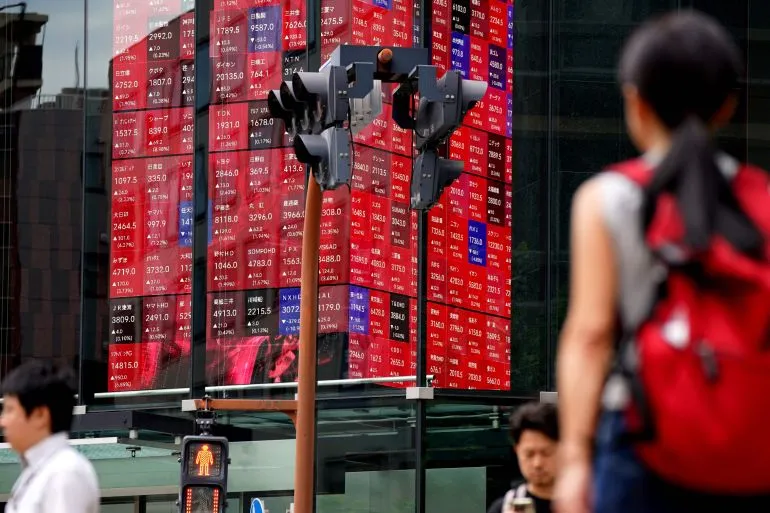
Japan has long been associated with economic stability, quality and progress: the world often sees it as a stable economy with few surprises and stability, with near-zero interest rates and deflation all year round. In contrast, crises are more often transmitted from the United States or Europe, where financial volatility is more common.
However, behind this apparent tranquility, Japan is undergoing changes that cannot be ignored, and if escalated, the impact could spill over to the global economy. This article thus sorts out the key aspects of the Japanese economy – huge debt, rising inflation, monetary policy inflection points and bond market repricing. Will Japan continue to be the fulcrum of financial stability, or will it be the source of the next global shock?
Gross Domestic Product (GDP)
Japan is the world’s fifth largest economy in terms of nominal GDP, with about $4.2 trillion in 2025 (estimates by the International Monetary Fund and the Organization for Economic Co-operation and Development).
Despite its size, economic growth has been weak over the past decade, often hovering between slowing and contracting, due to an aging population, declining productivity, and high dependence on external demand. This makes Japan a large economy with limited momentum, directly putting pressure on the government’s revenue structure.

Sources of government revenue
Japan’s public finances are dominated by taxes, accounting for about 60% of total revenue, and the rest is covered by government bonds and other financing channels. For the fiscal year ending March 2025, total tax revenue is approximately 75.2 trillion yen (approximately $522 billion), including consumption tax (more than one-third of the total), income tax, and corporate income tax.
Even at historic highs, revenues are still not enough to cover rising spending, especially inflated health and social security bills, forcing governments to continue borrowing to fill the gap.
Fiscal deficit
In 2024, the Japanese government will spend about $780 billion, tax revenue of $522 billion, and a deficit of about $258 billion (about 6% of GDP), continuing to accumulate debt. In 2025, the government will spend 115.5 trillion yen (about $770 billion), of which three-quarters will be covered by taxes and a quarter will be through bond issuance, raising the level of borrowing and interest burden again.
As interest rates rise, fiscal pressures are even more pronounced: budget requests for various departments totaled 122.45 trillion yen in fiscal 2026, a record high for the third consecutive year, highlighting the structural challenges of inflating debt service costs and public spending.
Debt burden: the biggest concern for stability
Japan’s national and private sector leverage far exceeds the size of its own economy, which is its structural vulnerability.
Government debt
Japan’s government debt is about $10 trillion, equivalent to 235% of the $4.2 trillion GDP in 2025. This part of the debt is mainly held by domestic institutions (banks, pension funds, insurance companies), which reduces external pressures but shows the government’s high dependence on domestic savings.
The ratio has risen from 196% in 2010 and 230% in 2020 to 235%+ in 2025. The absolute size is roughly $10 to $11 trillion, but the shrinking size of the economy has pushed up the debt ratio.
Private sector debt
The combined debt of enterprises, households and financial institutions is about US$7 trillion, or about 170% of GDP, including industrial and commercial finance, housing consumption and bank liabilities. High volume means more sensitivity to interest rate hikes or economic slowdown.
external debt
Japan’s overseas obligations are about $4.3 trillion, more than 100% of GDP. Despite its larger external assets, the liability is a potential weakness, leaving Japan vulnerable to market volatility and capital flows.
Total debt
The combined debt of the government and the private sector is about $17 trillion, more than 400% of GDP. Although most of them are locally financed, in the event of a global shock, the government may be forced to bail out its own financial institutions, further exacerbating fiscal vulnerability.
Inflation, wage pressures and output have fallen
Japan has been in a “deflationary era” for a long time, with stable or falling prices and near-zero inflation, forcing the Bank of Japan (central bank) to implement an extremely loose monetary policy for a long time. However, the situation has reversed in recent years:
In July 2025, the consumer price inflation rate (CPI) was 3.6% year-on-year, driven by food and energy. Food prices rose 7.6%, the fastest since February, with rice rising in particular.
During the same period, nominal wages rose by 4.1% and real wages rose by 0.5%, the first positive since December 2024. Japan’s union announced a wage increase of more than 5%, the highest since the 1990s, reflecting high price pressures due to the inflationary cycle.

In contrast, industrial output fell sharply. Industrial output fell by 1.6% month-on-month in July 2025, the largest decline since November 2024, with automobile production falling by 6.7% and machinery production falling by 6.2%. On an annualized basis, July decreased by 0.9% from an increase of 4.4% in June. Exports fell 2.6% for the third consecutive month, the largest decline since February 2021.
The consistency indicator fell to 113.3 in July from 115.9 in June, the lowest since February 2024. It can be seen that high inflation, combined with weak exports and falling output, is dampening real activity and laying the groundwork for changes in monetary policy and bond markets.
Monetary policy: an inflection point in the path of interest rates
After more than two decades of nearly zero interest rates, the Bank of Japan will face the reality of rising inflation and wages in 2025. In January, the policy rate was raised from 0.25% to 0.5%, the highest in 17 years, marking a gradual move out of ultra-easing.
The central bank has also begun to reduce its government bond purchases, reducing it by 400 billion yen per quarter, aiming to reduce its holdings by 7% to 8% by March 2026. The decline in bond purchases has lowered demand and pushed up yields, and the debt interest burden has risen.
Japan’s financial strength as the world’s largest creditor
Despite domestic pressures, Japan remains the world’s largest net creditor: net external assets of about $3.73 trillion in 2024 are distributed in U.S. Treasury bonds (about $1.1 trillion), Europe (about $4000 to $600 billion), China and Southeast Asia, and Australia (about $1000 to $200 billion).
This puts Japan in a key role in global financing stability, but if Tokyo suddenly adjusts its asset allocation, it could also be a source of spillover shocks.
Japanese government bond market: from “low-interest paradise” to “repricing”
Japanese government bonds (JGB) are one of the world’s largest bond markets, with a stock of more than $9.9 trillion. For a long time, thanks to zero interest rate and yield curve control (YCC), JGB has been almost equated with “cheap financing”.

But since inflation accelerated in 2023, the market has begun to repricing spontaneously. As of September 1, 2025: 10-year JGB yield of 1.63%, the highest since July 2008; 2.64% for 20 years, 3.30% for 30 years, and 3.50% for 40 years, and long-term yields rose to historical ranges.
The yield curve is the steeper in the world, with a spread of about 1.5 percentage points between the 30-year and 10-year periods. This means that long-term borrowing costs have risen far beyond the short end, reflecting investors’ hedging and concerns about inflation and fiscal sustainability.
The internal and external effects of rising yields
At the domestic level:
The Ministry of Finance intends to raise the assumed interest rate in the 2026/27 budget to 2.6% and allocate about 30 trillion yen (about $202 billion) for debt services. Real interest expenses will increase by 14.8% to 32.39 trillion yen (about $223 billion) in 2025, and may increase to 78 trillion yen (about $538 billion) per year in the next five years.
The two-year Treasury tender saw the weakest demand since 2009, indicating a decline in caution and confidence among local investors.
Overseas level:
Japanese institutions have long invested surplus funds in high-yield bonds in the United States and Europe. However, with hedging exchange rate costs eating up nearly half of overseas earnings and domestic bonds providing a return of more than 3%, funds are returning to JGB.
Large institutions (such as Asahi Life) have begun to reduce their holdings of U.S. Treasury bonds and increase their allocation of Japanese bonds, which has put pressure on the global bond market, especially the United States. U.S. public debt reached $37.4 trillion in September 2025, an increase of $1.2 trillion in two months, and the 10-year U.S. Treasury yield climbed from 0.65% in August 2020 to 4.10% (up 531%) in September 2025, and the 30-year bond rose from 1.36% to 4.78% (up 251%).
U.S. Treasury yields, as the anchor of interest rates such as mortgages, car loans, student loans, and credit cards, will rise due to the return of Japanese funds, which will raise the borrowing costs of U.S. households, curb consumption, and weaken the government’s ability to manage deficits.

Will Japan be the source of the next shock?
Japan’s changes are no longer “local news” but variables that are reshaping global financing rules. Its rising yields change international capital flows, exerting superimposed pressure on debt-dependent economies, especially the United States.
At a time when the credibility of “cheap money” is declining, global debt markets may become the stage for the next crisis, and Japanese bonds are likely to be the first spark.