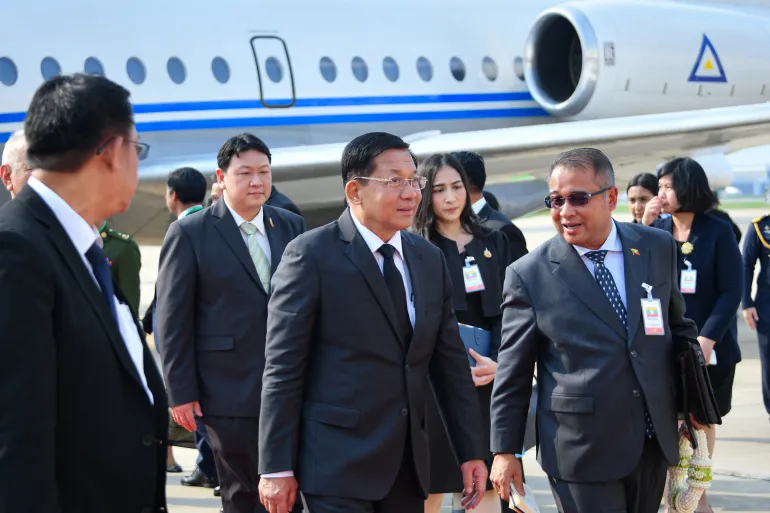
Myanmar’s junta leader Min Aung Hlaing is visiting Thailand for a regional summit, a rare international visit against the backdrop of Myanmar’s efforts to recover from a devastating earthquake that killed thousands.
Min Aung Hlaing was ostracized by most Western countries for overthrowing the democratically elected government led by Aung San Suu Kyi and subsequently imposing brutal repression at home. Since February 2021, when the Myanmar military seized power and began violently cracking down on the opposition, Min Aung Hlaing has not been allowed to participate in ASEAN (Association of Southeast Asian Nations) meetings.
However, Min Aung Hlaing was one of several leaders who traveled to Bangkok to attend the three-day summit of countries around the Bay of Bengal. After arriving in Bangkok on Thursday, Min Aung Hlaing was greeted by Thai Labor Minister Pipa at the local airport.
Subsequently, Min Aung Hlaing attended a formal dinner for the leaders of the seven countries of the Bay of Bengal Multisectoral Economic and Technical Cooperation Initiative (BIMSTEC), which includes Thailand, Myanmar, Bangladesh, Bhutan, India, Nepal and Sri Lanka.

According to state media reports, before the summit, which focused on technology and economic issues, Min Aung Hlaing also led his accompanying Myanmar officials to meet with Nepalese Prime Minister Oli. Photos released by the Thai government show the Burmese leader sitting between the prime minister of Bhutan and the prime minister of Sri Lanka during a dinner with leaders attending the summit of the “Rim of the Bay of Bengal Multisectoral Economic and Technical Cooperation Initiative” on Thursday.
On Friday, Min Aung Hlaing met with Thai Prime Minister Petuntan and Indian Prime Minister Narendra Modi. After meeting with Min Aung Hlaing, Modi posted on the X platform that the main contents of the discussion between the two sides include cooperation in connectivity, capacity building and infrastructure development.
According to Thai officials, the Myanmar military leader discussed with the Thai prime minister the issue of disaster prevention, transnational crime and the repatriation of personnel from the fraud center.
As the Bay of Bengal Multisectoral Economic and Technical Cooperation Initiative (RIM) summit is underway, Myanmar is still searching for survivors in the rubble left by last week’s earthquake.

The 7.7-magnitude earthquake destroyed thousands of buildings and caused bridges to collapse and roads to bend. The death toll rose to 3,085 on Thursday, with more than 4,700 injured and at least 300 missing, the Myanmar military said in a statement.
But while the Myanmar people are trying to cope with the aftermath of the earthquake, the Myanmar military has launched airstrikes against opposition armed groups, which has drawn anger and condemnation from the international community.
This week, the Myanmar military called for a temporary moratorium on operations against the armed opposition from Wednesday until April 22, reflecting some moves by the main opposition coalition and Myanmar’s shadow government, which is made up of some members of the previous government.
But the parties still say they reserve the right to act in self-defense, and there have been reports of sporadic fighting.
Meanwhile, protesters in Bangkok held up banners as the Myanmar military leader attended the summit and called him a “murderer.”
The Myanmar National Unity Government, a shadow government established by pro-democracy politicians who have been banned from taking office, also said it strongly condemned Min Aung Hlaing’s participation in the summit and believed he did not represent Myanmar’s legitimacy.
Myanmar’s government of national unity said it urged the Bay of Bengal Multisectoral Economic and Technical Cooperation Initiative to immediately disqualify the junta from participating in the summit and its related meetings.
The event organization Justice Myanmar said in a statement that the invitation to the meeting “legitimizes and expands the military junta that the people of Myanmar have been fighting against for more than four years and tarnishes the reputation of the Bay of Bengal Multisectoral Economic and Technical Cooperation Initiative as a regional organization.”
Min Aung Hlaing has already been subject to several global sanctions, and the ICC’s chief prosecutor has sought an arrest warrant for him and accused him of crimes against humanity against the predominantly Muslim Rohingya.
Thai Foreign Ministry spokesman Nikonde Barrancula told the Associated Press, “If we do not abide by the initiative’s founding charter, I think there will be an unfavorable situation.” ”
“Its charter stipulates that Thailand has the responsibility to invite all leaders of the Bay of Bengal Multisectoral Economic and Technical Cooperation Initiative.”