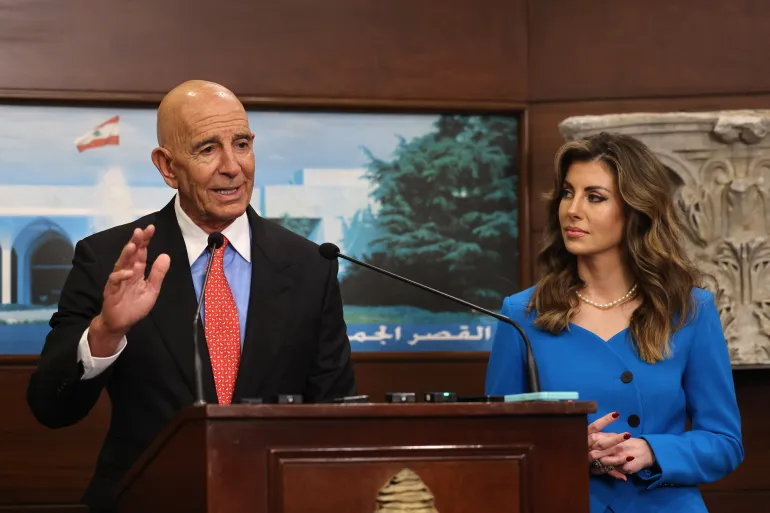
The United States has already put forward proposals to establish an economic zone in southern Lebanon. Analysts told Al Jazeera that the plan is far-fetched and unthought-provoked and is intended to motivate the Lebanese government to continue its efforts to disarm Allah.
The US special envoy to the Middle East, Thomas Barak, made a proposal to establish an economic zone during his visit to Lebanon on Tuesday, but did not provide details other than hinting at funding.
“All of us – the Gulf countries, the United States, Lebanon – will work together to create an economic forum that creates livelihoods,” Barak told reporters.
Experts say the idea can be referenced to similar areas created in Jordan and Egypt — both of which have peace agreements with Israel that Lebanon has difficult to replicate — especially after Israel’s war on Lebanon last year.
After the end of the war, which was mainly against Allah, regional and domestic calls for the disarming of the Lebanese army grew. The new Lebanese government, which took office in January this year, has announced its intention to disarm the organization under pressure from the United States and Israel.
Relieve the pressure on Allah to arm them
The war between Israel and Allah began on October 8, 2023, but intensified since September last year until a ceasefire agreement was reached on November 27 of the same year. Israel has repeatedly undermined the ceasefire agreement without any consequences.

Allah’s military capabilities in Lebanon suffered a blow during the war, and Israel managed to assassinate several of its leaders.
Allah is a member of the Iranian-backed “axis of resistance” that suffered a severe blow after the fall of Syrian President Bashar al-Assad in December last year and the Israeli attack on Iran (backed by the United States) in June this year, leading to a decline in Allah’s support in the region.
In Lebanon, Allah, once seen as the only Lebanese armed force capable of repelling Israel, has seen a sharp decline in support outside of its core domestic voter base in nearly 20 years, stemming from its takeover of Beirut in 2008, intervening in Syria on behalf of the Assad regime, and supporting counter-revolutionary forces during the 2019 Lebanese uprising.
Many political allies, including the Freedom Patriotic Movement and former presidential candidate Suleiman Frangia, have changed their attitude towards Allah and expressed support for its disarmament.
Forces opposing Allah in Lebanon have expressed their support for Allah’s disarmament, as it would concentrate power in the hands of the Lebanese government.
Today, Allah has lost its hegemony in Lebanon, and its opposition has demanded that Allah disarm, thus putting it in trouble.
To date, Allah has refused to disarm and has been heavily critical of the government.

In a speech on August 25, Lebanese Allah General Secretary Naeem Qasim said, “We will not give up the weapons that glorify us, nor the weapons that protect us from the enemy.”
He added that “if this government continues to maintain the status quo, it cannot be trusted to uphold Lebanon’s sovereignty.”
The trauma left by the war
In this war, Israel killed more than 4,000 people in Lebanon and displaced more than 1 million people. In this war, Israel has attacked Lebanon five times more than Allah or its allies have launched against Israel.
Despite the ceasefire agreement mandating Israel’s withdrawal from southern Lebanon, Israel continues to occupy at least five strongholds there and continues to destroy villages in the region.
During the war, Israel invaded southern Lebanon and forced people to flee, thousands of whom are still unable to return home — an area that the Israeli army has turned into an uninhabitable buffer zone through intensive bombardment and white phosphorus bombs.
Lebanese political analyst Karim Emir Bitar said that “the people of southern Lebanon still have lingering fears about the recent war,” and he also noted that this trauma would hinder any acceptance of the US economic zone proposal.
He went on to point out that “many Arabs, Muslims, and people in the Global South do not see the United States as an honest and reliable middleman.”

Analysts told Al Jazeera that Barak is likely trying to motivate the Lebanese people, especially those who support or participate in Allah, to further pressure the government to continue disarming against Allah.
“We have 40,000 people fighting on the mercenaries of Iran,” Barak asked, “What are you going to do with them? Take their weapons and tell them: ‘By the way, good luck in planting olive trees!’ ’”
Some media reported that the idea of establishing an economic zone in southern Lebanon was first proposed during a meeting between Israeli Strategic Affairs Minister Ron Demer and Barak in Paris, with the idea of building Lebanese state-owned factories in the area adjacent to the Israeli border.
Other details are not yet known. Every analyst interviewed by Al Jazeera said that it is difficult to imagine what such an economic zone could bring due to the lack of details.
Joseph Daher, author of Allah’s Political Economy, noted that after the signing of the Oslo Accords with Israel in 1993, Jordan and Egypt established so-called Qualified Industrial Zones (QIZs) to accommodate manufacturing.
To qualify as a qualified industrial zone, the products produced must come partly from Israeli inputs. Both Jordan and Egypt have normalized relations with Israel, while many Lebanese remain strongly opposed to this.

Such economic zones also face harsh criticism from experts.
“They operate like isolated enclaves and are disconnected from local communities, sometimes leading to the displacement of communities, and because they require a lot of land, their very existence can have serious environmental consequences,” Yasser Elsheshtawi, an adjunct professor of architecture at Columbia University in New York and author of “Temporary Cities: The Transient Nature of Arab Resistance,” told Al Jazeera.
He also added that “in many cases they play a role in violating workers’ rights, since the right to form a union is often prohibited”.
No one buys it
Even if such an economic project is implemented, many analysts doubt that it will gain the support or trust of local workers or residents.
“I don’t see any will or support on the ground,” Lebanese analyst and writer Michael Young told Al Jazeera. ”
Analysts say that residents of southern Lebanon do not consider the United States an honest participant and do not believe that the United States will serve Lebanon’s interests.
Qassem Kasir, a Lebanese political analyst believed to be close to Allah, said: “This idea has been rejected because of their lack of trust in the United States.” ”

After a brutal war with Israel, a close ally of the United States and the largest recipient of U.S. military aid, many Lebanese also find it hard to believe that U.S. actions are in their best interests.
“The economic zone can provide oxygen to help the struggling economy,” Bitar said, “but it still needs to overcome a series of obstacles, and the biggest obstacle at the moment is psychological, that is, the lack of trust. ”
Over the past 23 months, Israel has attacked its neighbors on multiple fronts, including the Gaza Strip, the occupied West Bank, Lebanon and Syria, while the United States has chosen to sit idly by most of the time.
“Especially in the past year and a half, the United States has not pressured Israel to stop its human rights violations, whether it is during the genocidal war in Palestine, during the occupation of Lebanon, or in Syria,” Dahel said. On the contrary, the United States has been supporting their actions. ”
Many supporters of Allah in Lebanon, who live within the geographical limits of the proposed economic zone, have publicly expressed their strong distrust of U.S. intentions on social media and beyond.

Some have expressed disappointment with the Lebanese government and accused it of acting on behalf of the interests of the United States and Israel.
Still, analysts say there is little political alternative to accepting the US and Israeli proposals, despite the lack of trust in US plans in the region.
“Because of the ‘October 7 incident’ (referring to the 2023 Hamas-led attack on Israel) and its devastating consequences in the region, the general population is suffering from the total hegemony imposed by the United States and Israel,” Dahel said. ”
“The normalization process takes time to implement, but in fact it is moving forward…… Therefore, it is more of a response to the status quo and the lack of a political alternative. ”
