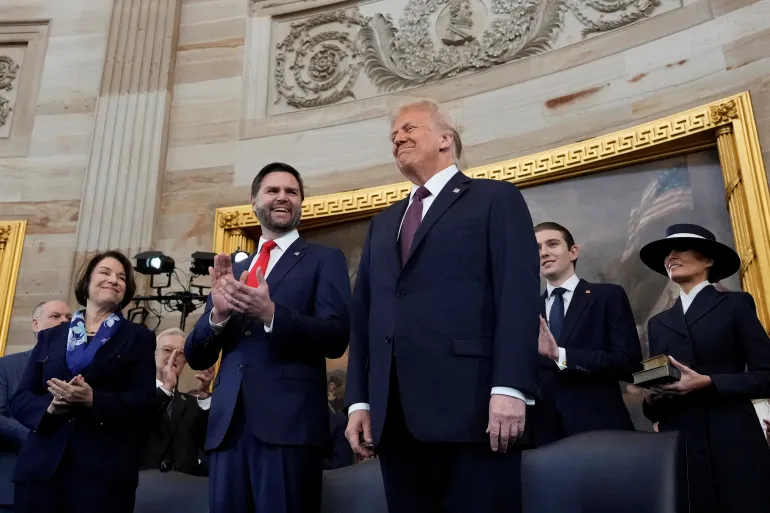
Trump was sworn in as the 47th president of the United States, thus successfully returning to the White House after his defeat four years ago.
On January 20, local time, the 78-year-old Trump slammed his predecessor, outgoing Democratic President Joe Biden, from the podium in the rotunda of the U.S. Capitol in an aggressive manner in his inaugural speech.
Trump also described himself as a victim of the “weaponization” of the government and slammed what he called a “radical and corrupt establishment.”
“I was recently elected to completely reverse the terrible betrayal,” Trump said, “and from this moment on, America’s decline is over.” ”
This is Trump’s second presidency, after he was in the White House from 2017 to 2021.
But Trump, who returned to the presidency on Monday, seems more confident than he was in his first presidential term, announcing his intention to sign a series of executive orders from the beginning of his presidency.
“Through these actions, we will begin to completely restore America and the revolution of common sense. It’s all about common sense”, he also cited the new pro-business energy policy and the fight against illegal immigration as one of his first actions.
Trump also promised to “expand” the U.S. border and warned Panama that he would “take back” the canal the U.S. built there.
Still, while Trump has once again described the United States as a country on the brink of collapse, he has tried to adopt a more optimistic stance than he did in his 2017 inaugural address, which came to be dubbed the “American Holocaust.”
“I return to the presidency with confidence and optimism that we are at the beginning of an exciting new era of national success,” Trump said. A wave of change is sweeping across the country. The sun is pouring down on the whole world. The United States has an opportunity to seize this unprecedented opportunity. ”

Biden made a last-minute preemptive pardon
But just hours before Trump’s inauguration, Biden also tried to defuse some of Trump’s campaign threats.
Trump has repeatedly promised to retaliate against those who criticize him, prompting Biden to take an extraordinary action: he preemptively pardoned those who could be prosecuted during Trump’s presidency.
Biden’s pardon provides protection for three targets that often provoke Trump’s anger, as well as Biden’s own family.
One of them is Dr. Anthony Fauci, an immunologist who has clashed with Trump over the country’s COVID emergency response. The other is General Mark Milley, one of the officials appointed by Trump but turned into a Trump critic, who served as chairman of the U.S. Army Joint Chiefs of Staff from 2019 to 2023, a panel of senior military leaders.
In addition, members of the U.S. House of Representatives’ Select Committee on the January 6 attacks, which investigated the January 6, 2021 attacks, were pardoned.
On the same day, a group of Trump supporters stormed the U.S. Capitol, apparently to block the certification process for Trump’s 2020 defeat.
In its final report, the commission filed criminal charges against Trump and accused him of aiding and abetting insurgencies against the government.
Trump has repeatedly threatened that members of the committee will go to jail, especially Liz Cheney, the most prominent Republican on the committee.
“For what they did, yes, honestly, they should go to jail,” Trump said in an interview with the TV show “Meet the Press” last December.
Biden mentioned these threats in a statement on Monday and warned that they could be prosecuted.
“Our country relies on dedicated, selfless public servants every day. They are the lifeblood of our democracy,” Biden wrote, “yet shockingly, civil servants are subjected to constant threats and intimidation for faithfully performing their duties. ”
However, Biden emphasized that these pardons “should not be mistaken for an admission of any wrongdoing committed by any individual.”

Trump calls for an end to the “weaponization” of justice
At noon EST (17:00 GMT), Biden and three other former U.S. presidents — Clinton, George W. Bush and Obama — entered the rotunda of the U.S. Capitol with other dignitaries to witness Trump’s second swearing-in ceremony.
In her opening remarks, Senator Amy Klobucher reminded the audience that the theme of this Monday’s inauguration was “Our Enduring Democracy.”
But when Trump took the podium to deliver his inaugural address, he was quick to portray the outgoing administration as a “corrupt government” without directly naming Biden.
In the opening minutes of his speech, Trump said: “Our sovereignty will be restored. Our security will be restored. The scales of justice will be rebalanced. The vicious, violent and unfair process of weaponization against the Department of Justice and our government will end.”
During his departure from the White House from 2021 to 2025, Trump became the first U.S. president to be charged and convicted of a felony.
He was convicted in May last year after a jury found him guilty of 34 counts involving falsification of business documents related to his concealment of hush money payments to an adult film star during the 2016 election.
But Trump also faces three other criminal charges. Among them is a state case in Georgia where prosecutors accused him of participating in a criminal conspiracy to undermine the state’s 2020 election results.
Until recently, Trump faced two federal indictments — one for allegedly trying to overturn the results of the 2020 election and the other for hiding classified documents while leaving office. Both cases were dropped last November, in line with the U.S. Department of Justice’s policy of not prosecuting the incumbent president.
Trump has long denied any wrongdoing in all cases against him and has accused Democrats of using the Department of Justice to carry out “political persecution” against him personally.
In a speech on Monday, Trump linked the criminal investigations to the assassination attempt he faced during his campaign in Butler, Pennsylvania, last July.
Trump said, “In the past eight years, I have been tested and challenged more than any president in our 250-year history. ”
“The journey to retake our republic was not easy – I can tell you. Those who wish to stop our cause are trying to take my freedom, even my life. ”

A state of emergency was entered at the southern border
Trump’s inaugural speech also sought to deliver on the promises Republicans made during the campaign.
He stressed that his priority is to declare a state of emergency on the southern border with Mexico.
Trump said, “All illegal immigration will stop immediately. We will begin deporting millions of criminal aliens to where they came from.”
As part of this effort, Trump explained that he would send troops to the border to “repel a catastrophic invasion against our country.”
He also pledged to reinstate the 2019 “stay in Mexico” policy, which requires asylum seekers to stay on the other side of the border while waiting for immigration appointments and court dates.
However, critics question that the policy violates domestic and international asylum laws, noting that asylum seekers have the right to cross international borders to escape persecution. They also argue that parts of the Mexican border are not suitable for migrants and asylum seekers to stay due to criminal activity.
Biden tried to terminate the policy shortly after taking office in February 2021, after which the policy has been embroiled in litigation.
Also in his inaugural speech on Monday, Trump reiterated his false claim that foreign countries are emptying prisons and mental hospitals at the U.S. border and promised to identify drug cartels as “foreign terrorist organizations.”
He then added that he would invoke the Foreign Enemies Act of 1798 – which allowed the President of the United States to detain and deport foreigners in times of war to combat “all foreign gangs and criminal networks.”
Trump said, “As commander-in-chief, my greatest responsibility is to defend our country from threats and invasions, and that’s exactly what I’m going to do.” ”
With an estimated 11 million unauthorized individuals living in the United States, human rights advocates fear that Trump’s proposed crackdown could extend beyond criminal networks and ultimately lead to divisions in families and communities.

Return to “Zhao Zhao Destiny”
Trump paints a picture of a good life in his upcoming presidency: America is thriving.
But in doing so, he used biased terms such as “Zhao Zhao Destiny”—a term associated with the westward expansion of North American colonialism and the forced expulsion of local indigenous peoples.
“The United States will once again see itself as a growing nation, a country that increases wealth, expands territory, builds cities, raises expectations and brings its flag to new beautiful horizons,” he said.
“We will pursue our bright destiny in the stars, send American astronauts to Mars, and plant the Stars and Stripes.”
On the eve of the inauguration, Trump repeatedly mentioned expanding the overseas territories of the United States.
In Central America, Trump urged Panama to “return” the Panama Canal to the United States, claiming unfair trade practices in the waterway built by the United States. In the northern region, he encouraged Canada to become the “51st state” of the United States. On the issue of Greenland, he also refused to rule out the possibility of using “military or economic coercion” to push for the annexation of the Danish self-governing territory.
In his inaugural address, Trump reiterated several of these issues and accused Panama of being “very bad” toward the United States.
“We gave it to Panama,” Trump said of the Panama Canal, “and we are going to get it back now.” ”
Trump also called for the Gulf of Mexico to be renamed “American Gulf” and said he would rename a mountain in Alaska (currently known as “Mount Denali” by indigenous peoples) to “Mount McKinley”.
In his speech, Trump described the colonial era in the United States as an era of victory and argued that Americans today need to regain the spirit of that era.
Trump said, “The spirit of the frontier is engraved in our hearts. The call to the next great adventure echoes from the depths of our souls”.
“Our American ancestors turned a small colony on the edge of a vast continent into a powerful republic of the most prominent citizens on earth. No one can match it. ”

A society of “equality of skin color and based on virtue”
As one of the portrayals of the American crisis, Trump paints a picture of the United States being hampered by censorship, a recurring theme in the conservative field in recent years.
“The federal government has illegally and unconstitutionally restricted free speech for years, and now, I will sign an executive order to immediately stop all government censorship and return free speech to the United States,” Trump said.
But he has thus turned to attacking educational efforts about racism and enduring racial divisions, including diversity initiatives in schools and businesses. Many conservatives have called for the repeal of these programs.
He also mentioned the promise he made during his campaign to repeal protections for transgender and non-binary Americans.
“I will also end government policies that seek to integrate race and gender into all aspects of public and private life,” he said. We will build a society that is based on ability regardless of color.”
“From today onwards, the official policy of the U.S. government will be that there are only two genders: male and female.”
Despite the divisive nature of Trump’s rhetoric, he has repeatedly described himself as a “unifier” who can usher in a new era of prosperity in his speeches.
Trump claimed, “My proudest legacy will be to be a peacemaker and unifier.” This is what I want to be: a peacemaker, a unifier,” he said, adding that this spirit will transcend the borders of the United States.
“We will be a unique nation of compassion, courage and exceptionalism. Our strength will stop all wars and bring a new spirit of unity to a world full of anger, violence and utter unpredictability. ”
Al Jazeera reporter Alan Fisher reported from Capitol Hill that the speech was “very dark.”
“This is Trump effectively clearing old accounts,” Fisher also compared the speech to Trump’s campaign speech.
Fisher noted that Biden and Trump’s rival in the 2024 election, Vice President Kamala Harris, sat in the audience “expressionlessly” and only stood up when mentioning the release of Israeli hostages in Gaza.