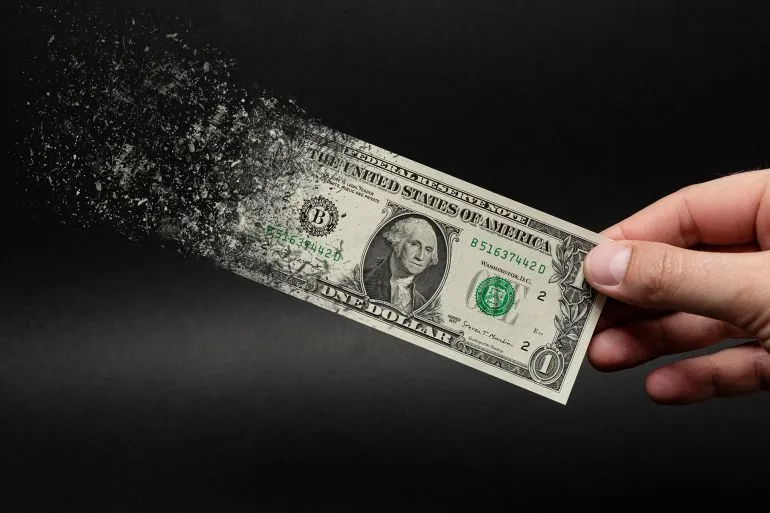
According to Bloomberg, a number of economic analysts and strategists warned that the dollar and other financial assets in the United States are facing increasing pressure and could lead to a new round of sell-off as concerns about the weakening credibility of the U.S. economic institutions intensify.
The situation stemmed from the resignation of Fed Governor Adriana Coogler last Friday, allowing US President Donald Trump to appoint his successor at a sensitive time for monetary policy, a move that could weaken Fed Chair Jerome Powell’s decision-making influence.
To make the market even more uneasy, Trump also fired Erica McHunt, acting director of the country’s Bureau of Labor Statistics, last week — which investors believe directly threatens the independence of U.S. economic data and exacerbates uncertainty about the outlook for monetary policy, thereby weakening market confidence in the dollar and related assets.
Robert Bergquist, chief economist at Ridbank Bank, said: “We are witnessing a dangerous trend of accelerating the concentration of executive power to the White House, which will inevitably lead to an increase in the risk premium of US assets. ”
A weaker dollar and loose monetary policy expectations
Although the dollar rebounded slightly at the beginning of last week, the dollar’s exchange rate against the G20 currency plummeted across the board on Friday after a weaker-than-expected jobs report, and the market expects the Fed to cut interest rates in September this year. According to Bloomberg data, the US dollar composite index has fallen about 8% year-to-date.
Elias Haddad, a strategist at Brown Brothers Harriman Bank, pointed out: “The credibility of U.S. policymaking is being severely eroded. Trump’s pressure on Powell and his colleagues to accelerate rate cuts undermined the Fed’s independence, while the firing of statistical officials eroded market confidence in the authenticity of U.S. economic data. ”

The Fed may usher in a “shadow chairman”?
Bloomberg analysis pointed out that Kugler’s resignation may accelerate the appointment process of a new Fed chairman. Trump is likely to nominate a successor who leans towards easing policies to take over the position after Powell’s term ends in May next year. This scenario could lead to the so-called “shadow chairman” phenomenon, where the market is starting to focus more on the policy tendencies of Trump’s nominee and see him as the actual helmsman rather than the current chairman Powell.
According to Bloomberg’s internal analysis, strategist Mark Coudmore believes: “Trump’s firing of the director of statistics is not likely to be positively interpreted – either there is a distortion of past data as he claims, or previously reliable data will be at risk of political interference.” In either case, the credibility of future data will be compromised and must be factored into the higher risk premium. ”

Potential Fed chairman
Derek Helpenny, head of global market research at Mitsubishi UFJ Financial Group, pointed out that Kevin Hassitt, director of the National Economic Council, would be “the most unfavorable option for the dollar” because he is too close to Trump. The nomination of incumbent Treasury Secretary Steven Mnuchin is similarly unfavorable, but slightly lesser.
Relatively popular potential candidates include former governor Kevin Walsh, current governors Christopher Waller and Michelle Bowman, all of whom have extensive experience in the Fed system. “Until the new chairman is announced, US dollar buying will continue to be limited,” Helpani said. “After Friday’s plunge, the dollar exchange rate was almost unchanged this Monday.
Deficit financing faces a double impact
Deutsche Bank expert Jim Reed’s team warned that “changing the Fed governor and the head of the statistics bureau at the same time could exacerbate the difficulty of financing the deficit of the US treasury and current account”, which could hinder the recovery of long-term bonds unless there is a significant economic slowdown.
Trump claimed on Sunday that he would announce the successors to Coogler and McHunt in the near future, which could be a key turning point in the relationship between the White House and U.S. economic institutions.