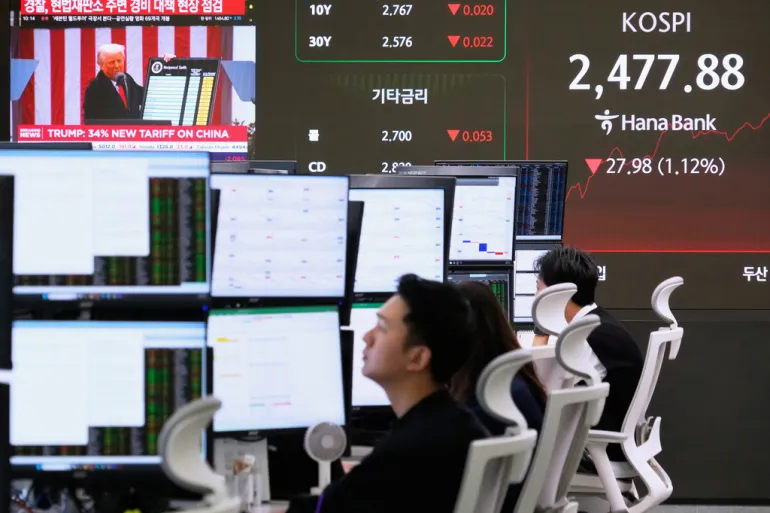
Stocks have been falling for weeks, extending further after US President Donald Trump announced tariffs on almost all countries on April 2.
Commentators on social media said that falling stock prices could signal a recession. Professional analysts at JPMorgan Chase & Co. estimate a 60% chance of a recession, while Goldman Sachs and Morningstar believe that the probability of a recession is between 40% and 50%.
So, what is a recession? Is there a link between a stock market decline and a recession? How is a tariff-induced recession different from previous recessions? Here are some answers to these questions.
What happens during a recession?
Several things tend to happen during a recession, and they are all unpleasant.
- Business investment declined, triggered by business leaders’ negative views on the economic outlook. The classic case is the “Great Recession” between 2007 and 2009, which triggered the collapse of the mortgage market. At the time, builders stopped building homes, which meant they stopped buying equipment and materials from excavators to refrigerators to roof tiles, and these decisions had a ripple effect on the economy as a whole.
- As a result of reduced investment in businesses, unemployment rises and working hours decrease. An economic recession in the early 80s of the 20th century brought the unemployment rate close to 11%, while the recession caused by the new crown epidemic once brought the unemployment rate close to 15%, and then fell at almost the same rate. Currently, the unemployment rate is well below 4.2%, but this level may change if economic conditions deteriorate. According to Steven Fazari, an economist at Washington University in St. Louis, “in a typical recession, the number of real unemployed is relatively low, but even the threat of unemployment can cause anxiety.”
- Even if they manage to keep their jobs, pay can stagnate because employees are less likely to find other jobs to fight for a raise.
- Consumer purchasing power declines. Gary Bethelis, an economist at the Brookings Institution, a think tank, said that “many households are more cautious about spending during recessions because they fear they may also face layoffs or other loss of income.” These factors tend to superimpose on each other and promote each other. For example, a decline in business investment leads to an increase in unemployment, which in turn leads to a reduction in consumer spending, which in turn leads to a decrease in business investment, ultimately leading to a further increase in unemployment.

How to judge a recession?
The official arbiter of the U.S. recession is the National Bureau of Economic Research’s Business Cycle Measurement Committee. For decades, this committee, which does not appear publicly, has been marking the beginning and end of recessions. Currently, the committee includes economists from Harvard, Princeton, Northwestern, MIT, and UC Berkeley.
The committee deliberates privately and takes a holistic approach rather than a list. But it discloses the factors it uses to judge the onset of a recession, namely “a significant decline in economic activity that spreads throughout the economy and lasts for more than a few months.”
The most recent recession – the one caused by the pandemic – is arguably the most unusual because it lasted for a short time, lasting only from February 2020 to April 2020, but it had a far-reaching impact and affected most sectors of the economy.
In media reports, a common criterion for judging whether a recession is occurring is a decline in gross domestic product (referring to the total amount of all economic activity) for two consecutive quarters. But the committee’s formal measures include factors such as inflation-adjusted personal income, nonfarm payrolls, household employment data, inflation-adjusted personal spending, inflation-adjusted manufacturing and trade sales, and industrial production.
It is worth noting that the stock market decline is not among them.

Is there a link between a stock market decline and a recession?
In 1966, Nobel laureate in economics Paul Samuelson joked: “The Wall Street index predicts 9 of the last 5 recessions. ”
While this is an exaggeration, his view is that falling stocks do not necessarily lead to recessions, and not all recessions cause stocks to fall.
However, history has proven a strong correlation between stock market declines and economic recessions, especially in the years following Samuelson’s remarks.
Since 1950, the United States has experienced 10 officially recognized recessions. Seven of them were accompanied by a decline in the S&P 500, a broad stock market indicator, while the other three were not. The last recession that failed to cause a significant decline in the S&P 500 index was nearly half a century ago, during the double-dip recessions of 1980 and 1982.
In the seven recessions that accompanied the stock market decline, the S&P 500 fell by an average of about 31%, ranging from 18% to 55%, of which 55% occurred during the Great Recession.
In contrast, the S&P has fallen by about 19% since the end of January 2025.
The biggest decline in stock market history occurred during the Great Depression: between August 1929 and July 1932, the S&P index (calculated slightly differently at the time) fell by 88%.
As Samuelson said, not every significant decline in the S&P 500 index will lead to a recession. For example, before and after the “Black Monday” crash in 1987, the economy fell by 28% due to various factors such as the international stock market sell-off, but did not cause a recession.
Most recently, during the highest inflation rate in the United States in 40 years, the S&P index fell by about 25% between January 2022 and September 2022. Although critics of then-US President Joe Biden believed that a recession was imminent and JPMorgan Chase also believed that there was a 40% chance of a recession, this did not happen.

If a recession does come, how will it be different this time?
It is too early to say whether there will be a recession. The stock market is an early indicator of potential economic problems — it’s based on investors’ perceptions of the economic outlook, not hard data. The data will need to be released in the coming weeks and months before the commission can make a final decision. It is important to note that the fastest decision is made about 4 months after the start of the recession, while the slowest decision is made 21 months later.
But if Trump’s tariff decision does trigger a recession, it may be characterized differently from other recessions.
The biggest difference is that this recession may be accompanied by rising inflation.
During a typical recession, consumer demand falls, which means that companies selling products and services lower prices (or at least do not raise prices) to attract consumers who are reluctant to spend. But Trump’s sweeping tariffs could push up prices while plunging the United States into a recession.
This is not without precedent. This also happened in the 70s of the 20th century, when the oil embargo caused gasoline prices to soar. Douglas Holtz-Ekin, president of the American Action Forum, a center-right think tank, said the phenomenon is called “stagflation” — a combination of economic stagnation and inflation. It is more “unpleasant” than a typical recession. (Also, don’t think prices would be better off — Bethelis said the economy could shrink so sharply that even with tariffs, prices would still fall, as happened during the Great Depression after the Smoot-Hawley Tariff Act of 1930.) )

Given Trump’s decision to impose tariffs of at least 10% on almost every country in the world, another extraordinary feature of the recession triggered by these tariff measures may be its simultaneous spread around the world.
Holz-Ekin said this could lead to a “global coordinated recession.”
Economists say the silver lining is — at least in theory — that the worst is avoidable. Unlike the complex mortgage industry problems that led to the Great Recession, or the global pandemic that triggered the 2020 recession, the US president has the power to quickly minimize (albeit uneliminated) the economic impact: he can simply eliminate these tariffs.
Liberal economist Daniel Mitchell said that if there is a recession this time, it will be “triggered by external shocks and is expected to end after the external shocks are eliminated.”