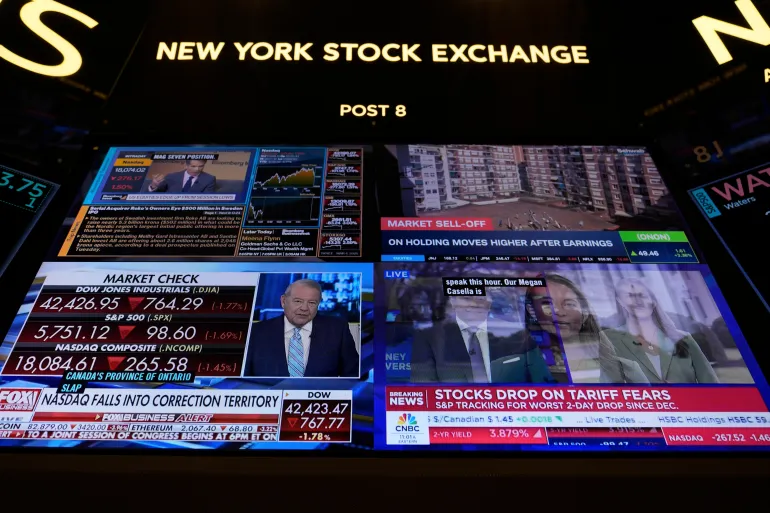
The market value of the U.S. stock market shrank by more than $1.7 trillion after U.S. President Donald Trump refused to rule out the possibility of the U.S. economy falling into recession this year.
The benchmark S&P 500 index fell 2.7% on Monday, dragging the index down nearly 9% from its all-time high set on Feb. 19.
The tech-heavy Nasdaq 100 index plummeted 3.81%, its biggest one-day drop since September 2022.
After two consecutive weeks of sharp declines, the S&P 500 and Nasdaq 100 are currently at their lowest levels since September last year.
Tesla, the electric vehicle company run by Elon Musk, saw its stock plummet 15.43%, the biggest drop among all companies. It should be noted that Musk has been called “Trump’s cost-cutting czar”.
Asian stocks fell on Tuesday morning, with Japan’s Nikkei 225 index and Taiwan’s weighted index TAIEX falling more than 2.5%, and Hong Kong’s Hang Seng Index falling about 1.5%.
The market crash comes as Trump’s repeated tariff measures have unsettled investors and raised concerns that the U.S. economy could slow down significantly or, in the worst case, fall into recession.

In a Fox News interview aired last Sunday, Trump had reservations about the possibility of an economic downturn when asked if he expected a recession this year.
“I hate predicting things like that. There will be a transition period because what we are doing is very significant,” Trump said, “and we are bringing wealth back to the United States.” This is a big deal…… It will take a little time, but I think it should be great for us. ”
“The market is full of uncertainty,” Steve Okuun, founder and CEO of Singapore’s APAC Advisors, told Al Jazeera.
“Trump now has no credibility on tariffs because of what he has done — especially with Mexico and Canada. That’s why the market reacts this way – they don’t know what to expect. ”
Trump imposed a 25% tariff on imports from Mexico and Canada last week and doubled the tariff rate on Chinese goods to 20%, but announced two days later that he would postpone some tariffs on Mexican and Canadian goods until April 2.
The 25% tariff on imported steel and aluminum will take effect on Wednesday.
Goldman Sachs economists last week raised the probability of a recession in the next 12 months from 15% to 20%, while JPMorgan Chase & Co. raised the probability from 30% to 40% due to “too extreme US policy”.
“Repetitive, confusing, and mixed information”
New York Stock Exchange trader Peter Tuchman called Monday’s trading session a “blood loss.”
In a video posted on the X platform, Tuchman said: “These stocks are being eaten away, obviously because of recession fears, right? ”
“Last week we experienced a rollercoaster of volatility, days of ups and days of decline – all caused by messages from the Oval Office of the White House, which was completely repetitive, confusing and mixed information, and the investment community lost confidence in the whole situation.”
Senator Elizabeth Warren, a Democrat representing Massachusetts, accused Trump’s policies of endangering the country’s economy.
Warren said on X: “Because of the president, we are in real economic trouble, and now, the stock market is like a warning light that keeps flashing.” ”
Among Republicans, Kentucky Senator Rand Paul also warned of a stock market crash, a rare divergence between Republicans and Trump.
Paul said on the X platform: “The stock market is made up of millions of people who trade at the same time.”
“Market indices are the refinement of emotions. When the market plummets due to tariffs, we need to listen to it. ”
In an interview with US media CNBC on Monday, Kevin Hassett, chairman of Trump’s National Economic Council, downplayed concerns about the health of the economy as “short-lived data.”
“I think the first quarter will go into a phase of positive growth, and then as everyone sees the reality of tax cuts, the second quarter will start to see growth,” Hassett said.